School Robotics Curriculum for Every Learner
RAISE GENIUS · ARTICLES & LEARNING
School Robotics Curriculum for Every Learner
A school robotics curriculum turns the knowledge behind a robot into lessons for a whole year group. Competition can inspire pupils, while regular classroom learning lets more children investigate physics, mathematics, coding and design through the same equipment.
Contact the teamOn this page
A school robotics curriculum beyond the competition team
The article asks schools to consider the pupils who are not selected to compete. A competition team may receive intensive time and resources, while the mechanisms and code behind the same robot can also support ordinary lessons.
The argument is for complementary roles: a school robotics curriculum as the foundation for everyone, with competition as an optional next challenge. It does not require abandoning a team or dismissing the effort of its pupils.
The opening school profile describes fifteen years of work and more than 12,530 learners at publication. Those are reported source figures, not a newly verified count.
Four learning areas inside one robot
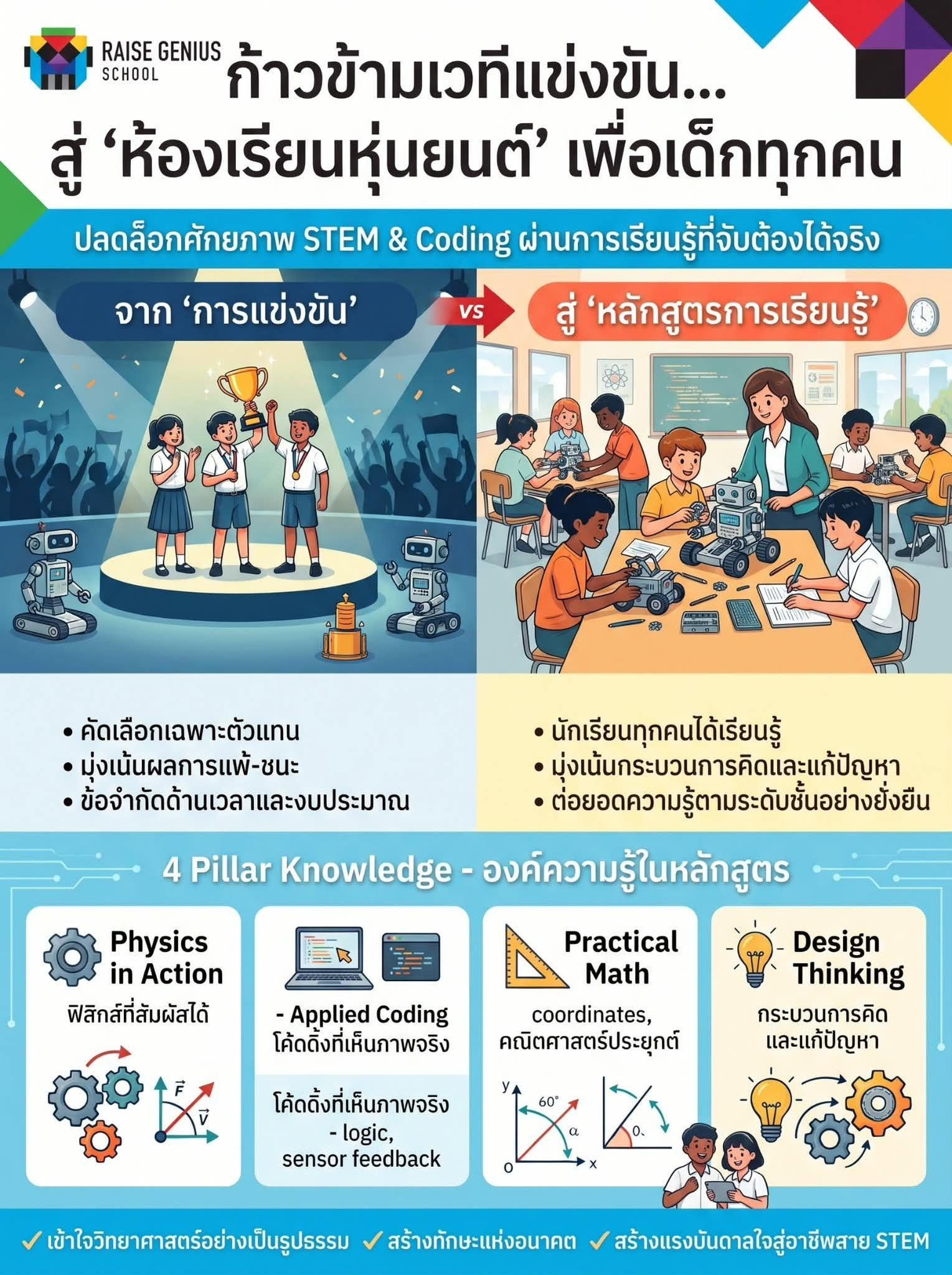
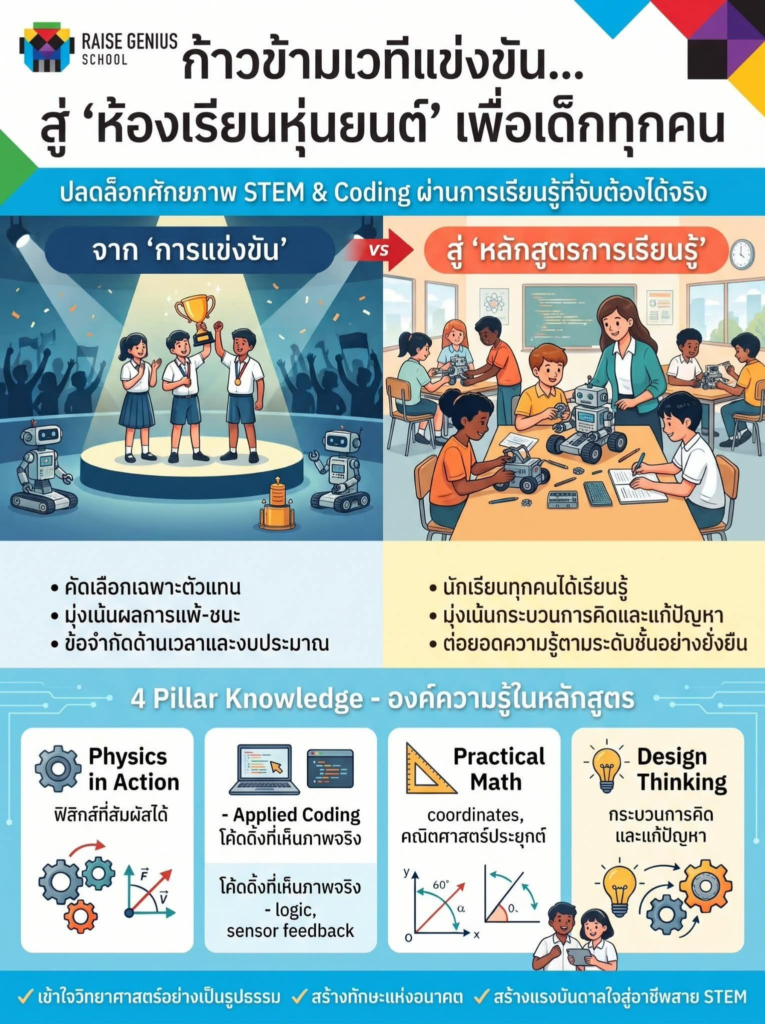
Physics: pupils can investigate forces, waves, sound, light and gears. A mechanism that moves slowly while pulling a heavier object gives a reason to discuss gearing.
Mathematics: turns, distance and vectors connect calculations to movement. The source example asks a robot to turn sixty degrees and travel forty centimetres, making the consequence of an error visible.
Computing: logic and problem solving can be tested through conditions and observable behaviour. Learners cycle through thinking, experimenting and revising rather than treating code as a copied answer.
Design thinking: a more complex mission can require planning, dividing tasks, trying an approach and changing the design. These learning opportunities depend on teaching and the mission, rather than arising automatically from owning a kit.
Progression through a school robotics curriculum
The source starts lower-primary pupils with mechanisms and block commands, develops sensors and conditions in upper primary, and moves towards more substantial programming in lower secondary.
Its FAQ describes Years 1-3 learning with gears and drag-and-drop blocks before text programming at a later stage. The wider school profile describes age-appropriate content from seven years through upper secondary.
Continuity matters: learning can accumulate across school years, while a competition season offers a different rhythm. Match a lesson to readiness and prior experience rather than assuming every child in a year group starts at the same level.
Compare a team-only approach with regular lessons
The article’s illustrative table contrasts representatives of roughly three-ten pupils per year with a curriculum intended for everyone in a year group, potentially hundreds. Those are comparison examples, not a quoted class size or a staffing commitment.
It contrasts competition outcomes and an intensive season with process/STEM learning across the school year. A team may use the kits exclusively, while planned lessons can rotate them through classes.
The lasting value of regular lessons includes knowledge teachers can reuse. The source encourages schools to inspect kits already stored for occasional competition use before assuming that a new programme requires replacing everything.
A sample fifty-minute Year 5 lesson
The mission is to deliver an object from table A to table B without hitting an obstacle. In the first ten minutes, pupils measure the route and calculate turns. In the next twenty, they build the needed mechanism and write block commands.
The remaining time is used for trials, adjustment and another run, ending with groups explaining a problem they solved. The source uses this as an imagined lesson example, not a universal timetable.
The same mission connects measurement, angles, forces, coding and presentation. The teacher needs to select goals and support pupils so that a practical activity becomes an opportunity to explain and reflect.
How a school can begin
The article says a school need not already have an engineering specialist to enquire. The school-service description includes curriculum support, kits and teacher training for regular subjects, clubs and STEM activities.
Start with the intended year groups, timetable, existing equipment and teacher preparation. Ask the team to specify a suitable programme and the support included, rather than assume all services are bundled.
Use the English school-service overview, lesson formats, teacher-training, lab-design and activity-station pages for related enquiries. A school robotics curriculum can provide the shared foundation, with coaching available separately for pupils who wish to compete.
Frequently asked questions
How is a curriculum different from a competition team?
A team selects representatives and works towards an event. A curriculum offers continuing lessons for a wider group or whole year. They can complement each other, with regular learning as the foundation.
Can lower-primary pupils begin?
The source describes Years 1-3 starting with mechanisms, gears and drag-and-drop blocks, then progressing towards sensors and more substantial programming as readiness develops.
Can a school begin without a computer-specialist teacher?
The source describes curriculum, kits and teacher-training support. Discuss the teachers’ background, year groups and existing equipment so the team can specify an appropriate proposal.
Contact and related pages
Tell the team about the learner or organisation, relevant experience and the intended learning purpose. Confirm the current programme, equipment, availability, schedule and fees before booking.
Contact Raise Genius School service overview
- Robot Coding with Graphic Programming & Python
- IoT Smart Farming Course for Beginners & Engineers
- Adult Robotics Training: Reskill & Upskill
- School Robotics Lab Design & Installation
- Should Children Still Learn Coding in the AI Era?
- STEM Articles & Learning Guides
Course-selection guide · Robotics portfolio projects · Competition preparation · Team advice and coaching · Course guide · General FAQ
Related services: School robotics camps · STEM activity stations
Source curriculum reference: IPST mission and education information (Thai).