
RAISE GENIUS · ARTICLES & LEARNING
Robot Coding with Graphic Programming & Python
Robot coding with Python connects a program to something a learner can build, test and explain. The source describes graphic programming for younger learners and Python for older learners, using LEGO Mindstorms robots to practise logical thinking and problem solving. The stated age range is 8-16 years.
Contact the teamOn this page
Learning through robot coding with Python
The course aims to develop systematic thinking: logic, sequence, where information comes from and how it is used. Project work lets learners apply programming knowledge immediately and discuss why a robot behaves as it does.
Pupils help shape projects around their interests, so persistence has a purpose. The source describes preparing children to become creators of robotics technology, alongside the enjoyment of thinking, making, experimenting, playing and presenting.
Projects are selected around the learner’s style, skill and stage. The original approach seeks a challenge that requires effort while remaining achievable with appropriate teaching. It emphasises the teacher’s interaction with the child rather than simply following computer instructions.
Six steps from a mission to a working robot
1. Receive a challenge from the teacher. The mission gives a purpose to construction and programming.
2. Design a flowchart and explain the proposed solution. Learners discuss the sequence before writing code.
3. Build the robot’s main functions and begin programming. The focus is on the mechanism needed for the mission rather than decorative detail.
4. Test repeatedly, then return to the robot and code to make changes. Robot coding with Python gives those tests a visible result.
5. Present the robot and run it live for a parent, or record a presentation to share with the family as arranged with the teacher.
6. Play, set a further challenge and develop confidence before trying a more demanding project. These are the source’s learning steps, not a fixed promise that every child completes the same design in one session.
Construction readiness before robot coding with Python
The source requires learners to be comfortable building LEGO EV3 or NXT robots. A working mechanism comes before meaningful control: turning angles and travel depend on wheel size and the distance between the wheels.
If construction is not yet fluent, the teacher recommends learning basic robot construction alongside this course. Age alone does not establish readiness for the programming tasks.
Younger learners use graphic programming. Older learners work towards Python after graphic programming has helped establish a firm understanding of algorithms. The page does not promise an immediate jump into Python without that preparation.
Objectives, teaching and presentation
The stated objectives are to learn programming through missions, develop computational and logical thinking, create an enjoyable atmosphere for experimentation, and help children discover their interests.
The original school profile describes small groups and teaching directed by graduates with undergraduate and postgraduate robotics backgrounds. It emphasises live problem solving and challenges that interest the child, including examples used in robotics competitions.
The source also describes opportunities to present work outside the classroom. Treat these as features of the published approach; confirm current group arrangements, teachers, equipment and presentation opportunities when enquiring.
A pathway through primary and secondary learning
The original pathway starts with interest and basic robotics in primary school, then graphic programming and robot coding with Python in upper primary and lower secondary. It moves towards Robot Maker projects in lower secondary and more advanced robotics, automation and portfolio work in upper secondary.
These are learning stages rather than a guaranteed progression timetable. A learner’s construction experience, ability to explain an algorithm and response to testing help determine a suitable next step.
Use the English course guide, robotics portfolio and project examples to discuss readiness. Ask the team to confirm the currently supported hardware/software, schedule, fees and whether parallel construction lessons are appropriate.
Original photographs and artwork
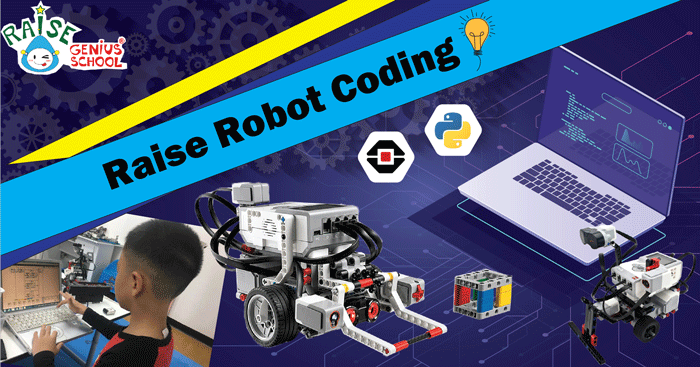
These images are retained from the original page as examples of published learning activities and programme information. Some contain Thai text or historical dates. They do not guarantee the same result for a new learner. Confirm current programmes with the team.
View original images
Frequently asked questions
What age range does the source give?
The page states ages 8-16. Construction experience and programming readiness also matter; discuss the learner’s stage with the teacher.
Does a child need to build robots already?
The source requires comfortable LEGO EV3 or NXT construction. If those skills are still developing, the teacher recommends basic construction alongside coding.
Do younger learners begin with Python?
Younger learners use graphic programming. Older learners work towards Python after graphic programming has established algorithmic understanding.
What is the role of a flowchart?
Learners plan and explain the sequence for a teacher’s challenge before building and programming. Testing then shows where that plan needs adjustment.
Is this a fixed project list or competition guarantee?
No. The approach adapts challenges to interests and skill. Competition examples do not guarantee entry, awards or the same outcome for every learner.
What should a family confirm before enrolling?
Confirm construction readiness, supported equipment and software, teaching format, group size, schedule, fees and any parallel construction lessons.
Contact and related pages
Tell the team about the learner or organisation, relevant experience and the intended learning purpose. Confirm the current programme, equipment, availability, schedule and fees before booking.
Contact Raise Genius School service overview
- IoT Smart Farming Course for Beginners & Engineers
- Adult Robotics Training: Reskill & Upskill
- School Robotics Lab Design & Installation
- Should Children Still Learn Coding in the AI Era?
- School Robotics Curriculum for Every Learner
- STEM Articles & Learning Guides
Course-selection guide · Robotics portfolio projects · Competition preparation · Team advice and coaching · Course guide · General FAQ
Related services: School robotics camps · STEM activity stations