
Recognising Containers, Recording a Return and Sorting
RAISE GENIUS · PARENTS & SCHOOLS
Recognising Containers, Recording a Return and Sorting
Recycling machine design ideas in this archive concern returning bottles and cans. The examples connect a community purpose with sensing, sorting and a reward system.
Contact the teamOn this page
Recycling machine design ideas begin with a purpose
The author discusses litter and the value of putting materials in an appropriate collection stream. A return machine is one possible part of that process, not a system that makes every kind of waste disappear.
The source describes overseas bottle-return machines with differing arrangements. Rewards, accepted items and recycling routes depend on the actual scheme rather than applying universally.
A Thai student-team example
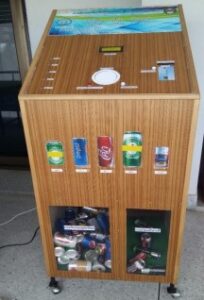
The archive attributes a can-return prototype to a team at Ubon Ratchathani Rajabhat University. It describes recording points in relation to accepted cans and sorting by size.
The source says intact cans were required at that time and that handling damaged cans or glass was a future development aim. Those plans should not be presented as completed capabilities or a current machine specification.
A plastic-bottle return example
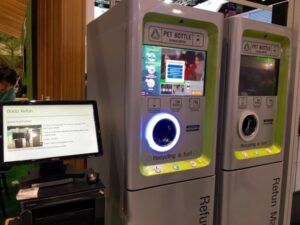
The article also names Refun:Waste Machine and describes options involving a payment, mobile credit or donation. These are historical descriptions, not confirmation of current payout rates, collection sites or supported services.
The useful design question is how a machine recognises an accepted item, records a return and separates it appropriately. A visible slot alone does not explain the whole process.
Use clean simulated materials in a learning model
A classroom can discuss recognition and sorting with suitable clean objects. Avoid handling broken glass, sharp cans or unknown waste as a casual activity.
Recycling machine design ideas can connect technology with a community goal, while prevention, reuse and the actual downstream recycling process still matter. No reward, environmental outcome or current installation is guaranteed by the archive.
Original photographs and artwork
These images are retained from the original page as examples of published learning activities and programme information. Some contain Thai text or historical dates. They do not guarantee the same result for a new learner. Confirm current programmes with the team.
View original images


Frequently asked questions
Does the archive confirm a machine accepts damaged cans now?
No. That was described as a future aim.
Are payout rates and locations current?
No. Confirm them with the actual scheme.
Should learners sort unknown or sharp waste?
No. Use suitable clean simulated materials and guidance.
Contact and related pages
Tell the team about the learner or organisation, relevant experience and the intended learning purpose. Confirm the current programme, equipment, availability, schedule and fees before booking.
Contact Raise Genius School service overview
- Instructions, Shared Services and Familiar Devices
- Guidance, Support, Power and Different Transport Concepts
- From a Checkout Belt to an Airport Baggage System
- A Wire-Walking Video and the Hardware–Software Relationship
- An Apparent Endless Mechanism Needs an Energy Explanation
- Changing Direction, Sharing a Load and Pulling More Rope
- Search, Training and What Self-Play Does Not Prove
- Hadrian, Wall Construction and the Rest of a Building
- Pretend Roles, Stories, Shared Building and Personal Designs
Course-selection guide · Robotics portfolio projects · Competition preparation · Team advice and coaching · Course guide · General FAQ
Related services: School robotics camps · STEM activity stations
Related learning: Raise Maker Arduino · micro:bit robotics · IOTBot & AI · Portfolio preparation · Camp proposal · Accompanying teachers
Related reference: NAEYC: developmentally appropriate practice

