
A Titanic-Inspired Model from the Student Archive
RAISE GENIUS · PARENTS & SCHOOLS
A Titanic-Inspired Model from the Student Archive
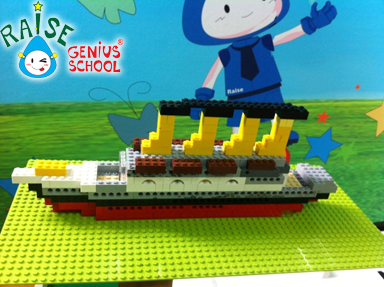
Marwin ship building project is a short classroom story about an imagined ship. The author identifies the model as Titanic-inspired rather than another robot.
Contact the teamOn this page
Marwin ship building project after a robotics activity
The archive says Marwin had time after completing a robot and chose to build a ship himself. P’Raise describes turning back to see a model taking shape as Marwin assembled and adjusted pieces.
The source reports that he was nine at the time and built from memory without opening instructions. These details belong to the author’s account of one historical classroom moment; they are not an independently timed or assessed result.
Notice proportions, connections and colour
The author highlights the relationship between length, width and height and the way differently coloured pieces were combined. These are concrete details a family can discuss while looking at the retained photographs.
Ask how the builder decided on the outline or represented a part of the ship. The original praises spatial ability, but a photograph of one model cannot establish a developmental age, an intelligence score or whether a learner is ahead of someone else.
An invitation to imagine another model
The source connects regular construction play with the work it celebrates. That is a classroom reflection rather than proof that a particular toy caused the result.
Marwin ship building project can inspire a learner to choose their own subject, explain a design and revise it. It does not promise that attending a course will reproduce the same model or developmental outcome.
Original photographs and artwork
These images are retained from the original page as examples of published learning activities and programme information. Some contain Thai text or historical dates. They do not guarantee the same result for a new learner. Confirm current programmes with the team.
View original images


Frequently asked questions
Who does the source credit for the ship?
It credits Marwin, a learner described as nine at the time.
Was it presented as a robot?
No. The article describes a Titanic-inspired construction model.
Does one model measure developmental age?
No. It is a classroom example rather than an assessment.
Contact and related pages
Tell the team about the learner or organisation, relevant experience and the intended learning purpose. Confirm the current programme, equipment, availability, schedule and fees before booking.
Contact Raise Genius School service overview
- A Learner’s Interest, Practice and Playable Model
- Teamwork and an Unexpected Use for a Model’s Mechanism
- An Older Invitation for Learners on a Different Holiday Calendar
- An Earlier “Discover Robotics” Event in Thung Khru
- The 2017–2018 FIRST LEGO League Season in Context
- A Historical Video as a Starting Point for Discussion
- Ships, a Great Wall Model and Sculptures
- An Older New Year Travel Article with a Pricing Correction
- A Craft Mechanism for Play, Not Valuable Storage
Course-selection guide · Robotics portfolio projects · Competition preparation · Team advice and coaching · Course guide · General FAQ
Related services: School robotics camps · STEM activity stations
Related learning: Raise Maker Arduino · micro:bit robotics · IOTBot & AI · Portfolio preparation · Camp proposal · Accompanying teachers
Related reference: NAEYC: developmentally appropriate practice


