
Fifteen Years of Making, Learning and Student Stories
RAISE GENIUS · PARENTS & SCHOOLS
Fifteen Years of Making, Learning and Student Stories
Robotics learning connects this anniversary account: building an idea, testing a model, explaining a project and reflecting on a longer learning journey at Raise Genius.
Contact the teamOn this page
Robotics learning and the school’s anniversary account
The original celebrates fifteen years of Raise Genius School and describes provision for learners from around age seven through secondary school, alongside further study support. It reports incubation through the University Business Incubator programme at King Mongkut’s University of Technology Thonburi, or KMUTT.
The anniversary is the publication’s framing of its own history. The text should not be used to calculate a new foundation date or assume that every staffing, enrolment or service detail remains unchanged. Families and schools can use it to understand the institution’s stated purpose, then confirm the arrangements relevant to them.
The source describes thousands of learners participating over the years. That is the school’s own account, not an independently audited enrolment figure presented by this translation. It does not imply that every learner has followed the same path or reached the same result.
An idea about teaching and a team to support it
The source introduces Teacher Num, whose postgraduate robotics and automation background is associated with the Institute of Field Robotics, FIBO. His teaching idea is to encourage children to want to make and investigate something themselves.
The article reports a team of more than ten robotics engineers at publication and describes work with children, secondary learners and some early university learners. It also mentions live online teaching across Thailand and learners in other countries, including the United Kingdom and China, as well as robotics curricula for Thai schools.
These details describe the anniversary account. When comparing an actual class, ask who will teach it, how support is organised and what preparation or equipment is needed. A team’s general background does not by itself specify the experience of an individual lesson.
Robotics learning through competitions and public projects
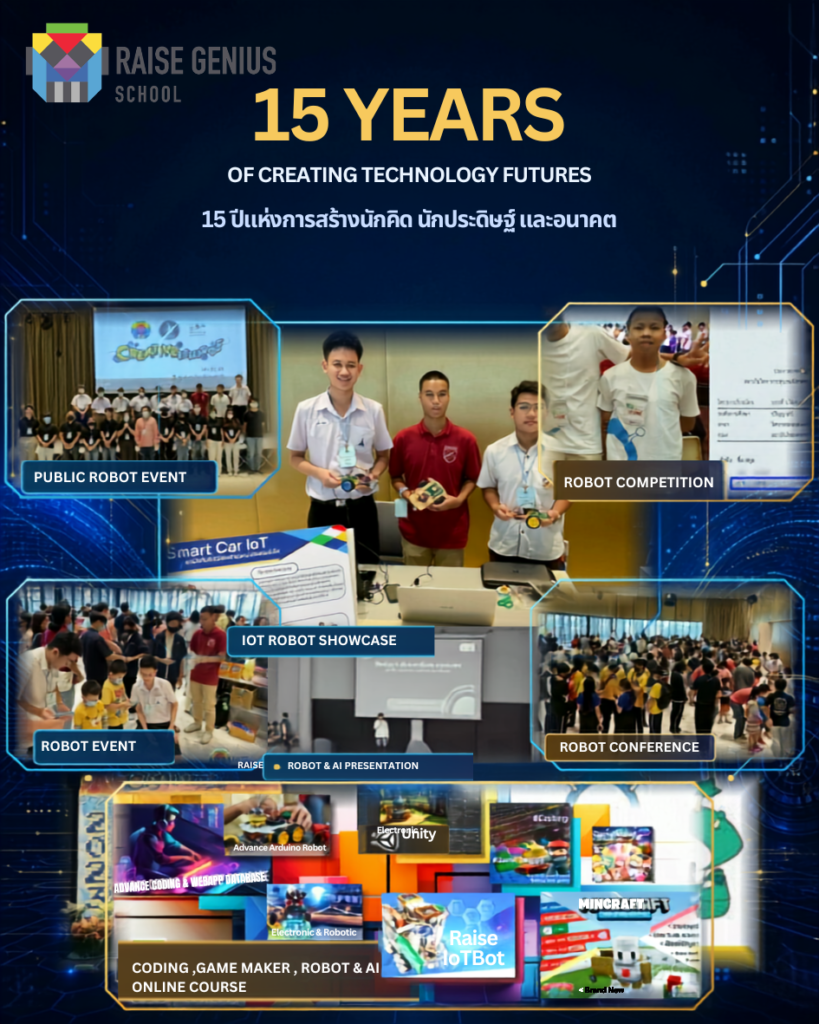
The school describes coaching for FIRST LEGO League, the World Robot Contest in China, and the World Robot Olympiad. The source presents these as opportunities to practise programming, respond to a challenge and share responsibility with a team.
It also describes public robot events and conferences where children can show a project and explain it to others. A demonstration can include the intended purpose, a decision made during construction and what happened in a test. Participation is a learning opportunity rather than proof of a particular level of confidence.
IoT Robot Showcase and Robot & AI Presentation are other examples named in the source. Smart-car IoT, automation and AI projects give a learner something concrete to explain. The account also includes school robotics camps, science-day workshops, classroom setup and teacher training.
Event names in a history article are not an invitation to enter a current competition. Requirements, availability, location, dates and fees need to be checked for the actual event. A past coaching activity does not guarantee a place, prize or result for a new participant.
Robotics learning and an authentic portfolio
The article connects a longer sequence of projects with a portfolio for further study. It mentions robotics, mechatronics, computer engineering and ICT as possible interests, and refers to the Thai TCAS portfolio round.
The source argues that making over time can give a learner evidence to discuss: the task, their own contribution, what they changed and what they learned. A record of a project or team experience can be useful material, provided it accurately reflects what the applicant actually did.
This translation does not promise admission, claim that a portfolio replaces every other requirement, or repeat the suggestion that the process necessarily prevents dropping out. Each university, programme and admission cycle sets its own criteria. A family should check the institution’s current official information before preparing an application.
A robotics learning record is most useful when the learner can explain it in their own words. Photographs, code or results can support that explanation, but collecting impressive-looking material is not the same as demonstrating understanding or authorship.
A learner’s story: Chompoo and FIBO
The anniversary account shares a story about Chompoo, described as an early learner in a school where Raise Genius taught. It says that building LEGO models helped her discover an interest in creating something new.
The source describes her continuing with maker-style robotics competitions and collecting her own work into a portfolio. It reports that she was accepted to an undergraduate programme at FIBO, KMUTT, through a portfolio route, becoming a junior alumnus of the founder’s institute.
This is a student story reported by the school. It is not independently reverified here, and one person’s experience cannot predict another applicant’s outcome. Its practical theme is sustained participation and work the learner can discuss, rather than a guaranteed path to a named university.
Robotics learning across three periods
For years one to five, the source describes a small robotics classroom, early LEGO building and programming, and the first schools that invited the team to teach. This is its pioneering period.
For years six to ten, it describes expansion into Arduino electronics and IoT, live online provision and more structured competition coaching. Online access is presented as a way to reach more locations; it does not establish that equipment, connectivity or support needs are identical for every household.
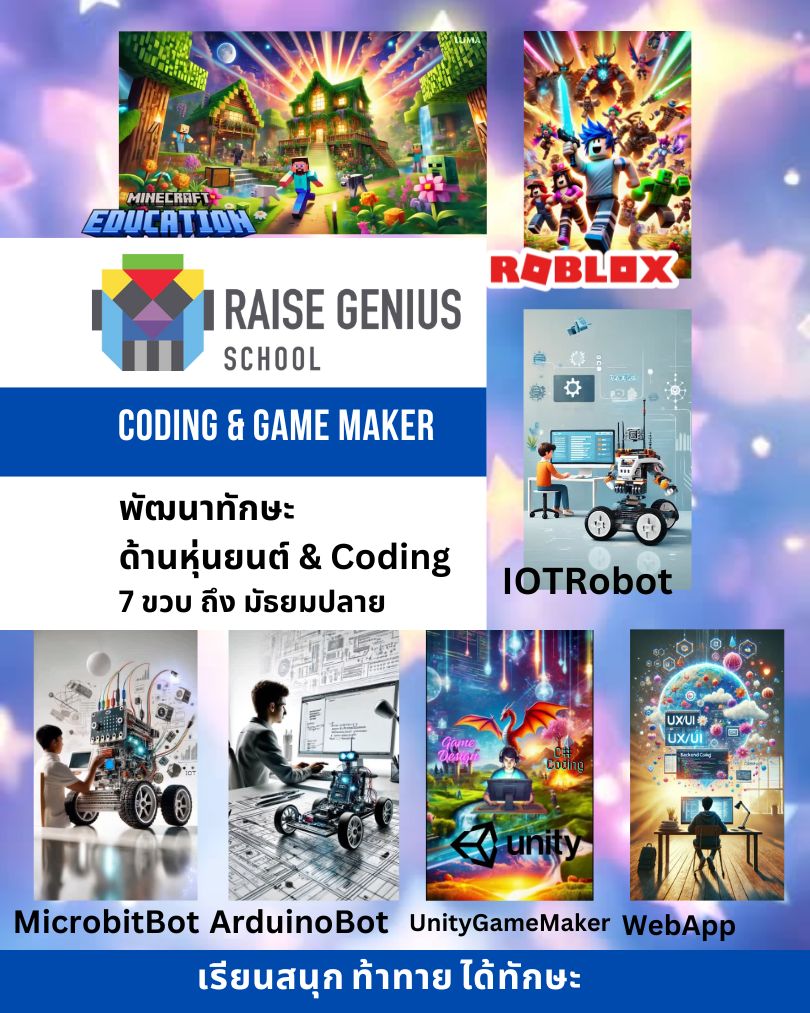
For years eleven to fifteen, the account highlights IOTBot & AI, game-making examples such as Roblox, Unity3D and Minecraft Education, and more systematic preparation of project portfolios. The timeline is preserved as the school’s broad anniversary narrative rather than a newly audited chronology.
What the intended practice can involve
The source identifies systematic thinking through planning, designing, assembling, programming and testing. A learner may need to connect several parts of a task rather than memorise an isolated command.
It also discusses persistence and debugging. An attempt that does not work as planned can provide something to inspect and change. This does not mean every robot fails on its first test or that a frustrated learner should be left without help.
Explaining work is another intended practice area. A short classroom demonstration and a public presentation have different demands, so suitable support matters. The article’s examples do not guarantee that every learner will present in every lesson or attend a national event.
Finally, the account values tangible work that can be recorded over time. Ask how the learner’s role is documented, how feedback is shared with families and what can be taken away from the actual class. These questions connect the broad robotics learning story with a practical plan.
Robotics learning pathways by age and experience
The source suggests LEGO and block-based coding for ages seven to nine, with enjoyment and a positive introduction as the starting purpose. For around ten to twelve, it discusses more complex robot programming and game-making examples.
It separately mentions Roblox provision from age nine with some block-coding experience. These are course examples from the source, not permission to bypass any platform’s account, age, consent or safety requirements. The school and family should confirm the actual tools and eligibility for the learner.
For lower secondary learners it describes Arduino, electronics, IoT, individual projects and possible competitions. For upper secondary learners it discusses more advanced AI or Unity3D projects, organising a portfolio and practising an explanation of the work.
An age band is a planning aid, not a diagnosis or a promise that every learner should progress at the same speed. Prior experience, purpose, available time and the support needed can all change the appropriate starting point.
Ask about the next step that fits the learner
The anniversary closes by describing a wider range of offerings: Arduino robotics, IoT and AI, Minecraft Education coding, Roblox and Unity3D game creation, and WebApp and database work. It thanks families, schools and partners for their involvement.
For a new enquiry, describe the learner’s interests, experience and intended purpose. Ask which programme is available, how it is taught, what equipment or accounts are required, and how teachers communicate about progress. For a school, discuss the group and learning setting rather than assuming a family-course arrangement transfers unchanged.
Confirm current online or in-person availability, class size, timetable, fees and any trial conditions. The source’s age examples, staffing figures and historical achievements give context, while the actual booking details belong to the current conversation with the team. Robotics learning can begin with an appropriate activity without a promise of a specific career or admissions result.
Original photographs and artwork
These images are retained from the original page as examples of published learning activities and programme information. Some contain Thai text or historical dates. They do not guarantee the same result for a new learner. Confirm current programmes with the team.
View original images

Frequently asked questions
At what age can a learner start?
The source describes a pathway beginning around seven and extending through secondary study and some early university work. Confirm current placement using the learner’s experience, needs and the programme’s requirements.
Can someone without prior experience enquire?
Yes. The source describes starting from foundations. Ask about a suitable first task, class size, equipment and support rather than assuming every course has identical entry requirements.
Does robotics learning guarantee university admission?
No. Authentic projects may provide material for a portfolio, but each university and programme sets its own requirements. The reported alumni stories are not promises for another applicant.
Are both online and in-person classes available?
The anniversary account describes both, as well as services for schools. Confirm the current location, delivery format, available dates and conditions with the team.
Contact and related pages
Tell the team about the learner or organisation, relevant experience and the intended learning purpose. Confirm the current programme, equipment, availability, schedule and fees before booking.
Contact Raise Genius School service overview
- How the Archive Describes Raise Genius School’s Approach
- Six Steps for Comparing a Child’s Holiday Camp Options
- Holiday or Weekend Robotics? Read the Archive’s Format Comparison
- Kind, Clear and Supportive Communication with Learners
- What Does Raise Genius Want Learners to Gain from a Team?
- Seven Areas to Explore When You Want to Build a Robot
- Why the Founder Wanted Children to Build Robots
- Raise Genius Values: Make, Share and Take Part
- The Archive’s Path from Parts to Independent Challenges
Course-selection guide · Robotics portfolio projects · Competition preparation · Team advice and coaching · Course guide · General FAQ
Related services: School robotics camps · STEM activity stations
Related learning: Raise Maker Arduino · micro:bit robotics · IOTBot & AI · Portfolio preparation · Camp proposal · Accompanying teachers
Related reference: LEGO Education: hands-on learning


