
Curved Motion, Contact Forces and Engineered Restraints
RAISE GENIUS · PARENTS & SCHOOLS
Curved Motion, Contact Forces and Engineered Restraints
Roller coaster science questions begin with why a train and its riders follow a curved track. The archive’s explanation needs a distinction between motion and safety systems.
Contact the teamOn this page
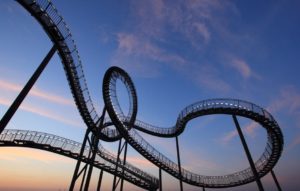
Roller coaster science questions about a loop
The source describes the sensation of being pressed against a seat and asks why the train does not simply fall away during an inversion. In an outside reference frame, following a curved path requires acceleration towards the centre of curvature.
Gravity and contact forces contribute according to position and speed. The outward sensation discussed in the archive is often described in the rider’s turning frame; it should not be mistaken for a universal outward force that alone holds every train safely on a track.
The model and the real ride are different
The original suggests swinging a partly filled bottle to observe water. This edition treats it as a described analogy, not an unsupervised instruction to swing an object near people.
A teacher can choose a suitable demonstration or diagram and discuss what it represents and what it leaves out. One informal experiment cannot certify the safety of a ride or reproduce all the forces on a real train.
Engineered systems matter
The archive also recognises that theory alone is insufficient. Track engagement, restraints, braking, inspection and operating procedures belong to the engineered system; speed is not the only safeguard.
Roller coaster science questions can inspire a small model or a discussion with a teacher. They are not a plan for a ride carrying people, and visitors should follow the operator’s actual restrictions and instructions.
Original photographs and artwork
These images are retained from the original page as examples of published learning activities and programme information. Some contain Thai text or historical dates. They do not guarantee the same result for a new learner. Confirm current programmes with the team.
View original images
Frequently asked questions
Does an outward force alone make a ride safe?
No. Motion, contact forces and engineered systems need to be distinguished.
Is the bottle analogy a ride safety test?
No. An analogy does not certify an engineering design.
Should a child build a ride for people from this article?
No. Use an appropriate learning model and qualified guidance.
Contact and related pages
Tell the team about the learner or organisation, relevant experience and the intended learning purpose. Confirm the current programme, equipment, availability, schedule and fees before booking.
Contact Raise Genius School service overview
- Positioning, Obstacle Sensing and Service Applications
- Observations, Computer Models and Communicating the Result
- Observation Tools and a Necessary Product Safety Correction
- The Thames Barrier, Boxwall and FloodBreak
- Chemistry, Fingerprint Traces and Reconstructing a Scene
- Infrared, Radio and the Actual Classroom Equipment
- Materials, Propulsion, Navigation and a Historical Correction
- Ideas, Gliders, Control and Building on Earlier Work
- Movement, Mission Tools and the Operating Environment
Course-selection guide · Robotics portfolio projects · Competition preparation · Team advice and coaching · Course guide · General FAQ
Related services: School robotics camps · STEM activity stations
Related learning: Raise Maker Arduino · micro:bit robotics · IOTBot & AI · Portfolio preparation · Camp proposal · Accompanying teachers
Related reference: NAEYC: developmentally appropriate practice
