Planning Robotics Stations for School Events
RAISE GENIUS · PARENTS & SCHOOLS
Planning Robotics Stations for School Events
Robotics stations for school events need a schedule that gives each pupil a practical turn. The source’s title mentions three to four hundred learners, while its opening discusses a six-hundred-pupil school. Those are planning examples, not a verified one-day capacity promise. Start with attendance, available time and station flow.
Contact the teamOn this page
Robotics stations for school events differ from a full camp
A full camp keeps the same group with a project over a longer period. The source describes a three-day, six-hours-per-day primary example at Yuwapat in Nakhon Sawan, progressing through construction, testing and a challenge.
A school open day, academic day or Science Day may bring many pupils past an activity in a shorter period. The source’s aim is a meaningful practical turn, rather than completion of the same substantial project by every visitor.
Confirm what each pupil will do, how long that action takes and how groups move. The article does not give a complete numerical throughput calculation; ask the team to propose the actual rounds before claiming every pupil can finish in one day.
Three robotics stations for school events in the source
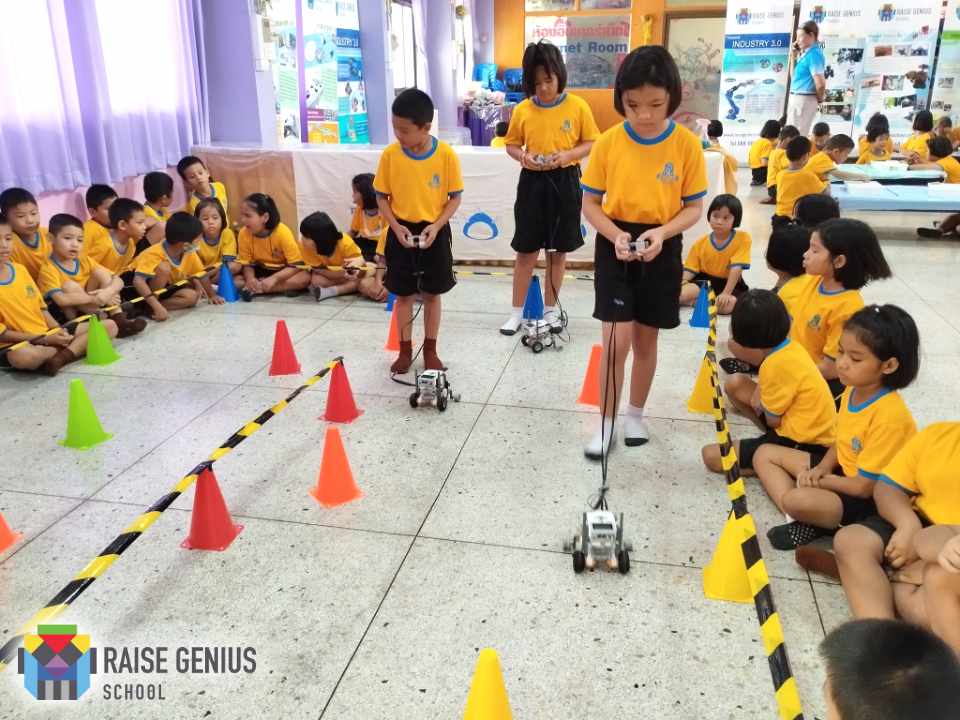
Robot mission course: pupils use a controller to guide a LEGO robot through cones and obstacles. The task can encourage attention and planning through an observable result.
Sumo robots: the source describes adding parts to a robot before it enters an activity area. Agree the actual construction and challenge scope for the time available.
Box-pushing robot control: a mission can invite logical decisions and sharing roles within a team. Make sure a turn means doing part of the task, rather than only watching a classmate.
The article advises separating popular queues instead of placing the busiest stations immediately together. Combine station layout and group movement with the school teachers’ practical knowledge of the venue.
Responsibilities for robotics stations for school events
The source describes the visiting team bringing agreed robots and teaching materials and leading technical activities through instructors who regularly teach children.
The school supplies suitable space and accompanying teachers. Those teachers know pupils and help queue organisation and participation while the visiting team focuses on equipment and content.
Discuss station count, dates, event hours, learner years, group sizes, the meaning of a practical turn and the available accompanying staff. A quoted total should follow that plan instead of replace it.
When a larger event needs several days
The original suggests spreading very large participation, such as a thousand or more learners, over two or three days so each group has a realistic amount of time. Capacity depends on the task, stations, staffing, transitions and breaks.
The article’s references to past activities at Anuban Ratchaburi, Daruna Ratchaburi and Wat Nang Sao illustrate the archive. They do not certify that another venue can use the same schedule unchanged.
Keep the intended experience clear: even a quiet pupil should have an opportunity to control, build or test something. Compare the agreed schedule with that goal before the event, then review what actually happened afterwards.
Frequently asked questions
Can a large school guarantee everyone a turn in one day?
Not from a pupil total alone. Agree station numbers, practical task time, rotations, transitions and staffing. The source gives different scale examples and does not establish a universal daily capacity.
What equipment does the school have to buy?
The source describes the visiting team bringing agreed robots and teaching media. Confirm the exact scope in the quotation; the school still provides the venue and accompanying teachers.
When should an event be spread over several days?
When the proposed stations and available hours do not give each group enough time. The source suggests a multi-day arrangement for very large attendance, subject to an agreed schedule.
Contact and related pages
Tell the team about the learner or organisation, relevant experience and the intended learning purpose. Confirm the current programme, equipment, availability, schedule and fees before booking.
Contact Raise Genius School service overview
- Study Paths for Young Inventors: Five Options
- School or Offsite Robotics Camps: Five Checks
- Individual or Group Coding Lessons for Children
- Academic or Vocational Robotics after Lower Secondary
- Choosing a Robotics Engineering Degree: Interests, Labs & Projects
- Preparing a School Robotics Camp Venue
- Robotics Camps for Small Schools: Start with the Group
- Primary and Secondary Robotics Camps: Match the Challenge
- An Authentic TCAS Portfolio: Show Your Own Work
Course-selection guide · Robotics portfolio projects · Competition preparation · Team advice and coaching · Course guide · General FAQ
Related services: School robotics camps · STEM activity stations
Related learning: Raise Maker Arduino · micro:bit robotics · IOTBot & AI · Portfolio preparation · Camp proposal · Accompanying teachers
Related reference: IPST STEM resources (Thai)