
A Guide to the Archive’s Discussion of Cognitive Development
RAISE GENIUS · PARENTS & SCHOOLS
A Guide to the Archive’s Discussion of Cognitive Development
Piaget and learning activities are connected in this archive through sensory play, pretend play, puzzles and programming. The stages provide historical context.
Contact the teamOn this page
Piaget and learning activities: listen to the explanation
The article introduces Jean Piaget and his interest in children’s reasoning. Instead of considering only whether an answer was right, the important question was how the child reached it. The source contrasts this with treating children simply as smaller adults.
The four periods below summarise the framework discussed in the archive. Their age ranges are approximate teaching context, not fixed deadlines, course entry rules or a way to diagnose an individual learner.
Sensorimotor and preoperational periods
First, the sensorimotor period, approximately birth to two years, concerns learning through perception and action. The archive gives noticing colours, smells and movement as examples.
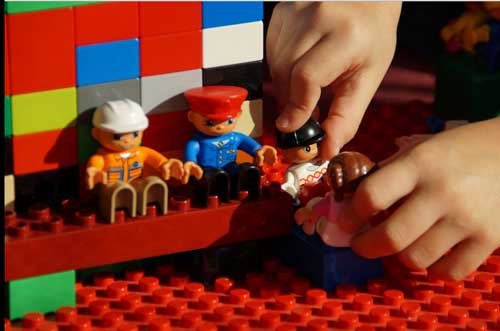
Second, the preoperational period, approximately two to seven years, includes symbolic and pretend play. The source suggests role-play sets and construction toys. Children can explore any role regardless of gender; a toy does not need to teach fixed roles for boys and girls.
Concrete operations and more complex games
Third, concrete operations, approximately seven to eleven years in the source, concern reasoning about tangible situations. Sorting, grouping and discussing familiar experiences are useful examples.
The article connects this period with puzzles, jigsaws, board games with more complex rules and construction models. Let learners explain a pattern, compare two arrangements or change a rule while keeping the task manageable.
Formal reasoning and supported investigation
Fourth, formal operations involve reasoning about possibilities and hypotheses. The archive gives approximately eleven to fifteen years and connects the discussion with research, computers, tablets and LEGO MINDSTORMS programming.
These examples do not mean technology or hypothesis questions must wait for a specific birthday. A younger learner may explore a simple prediction with concrete materials; an older learner may still benefit from them. The teaching decision should consider the person, task and context.
Use the framework as a conversation starter
Ask what the learner tried, what changed and what evidence supports an explanation. Construction can connect a visible mechanism with an instruction sequence, while play and discussion make different approaches visible.
The archive’s invitation to learn robotics is retained through the related course links. Confirm current equipment and teaching arrangements with the team; the article is an educational introduction rather than an assessment service.
Original photographs and artwork
These images are retained from the original page as examples of published learning activities and programme information. Some contain Thai text or historical dates. They do not guarantee the same result for a new learner. Confirm current programmes with the team.
View original images


Frequently asked questions
Are Piaget’s age ranges exact deadlines?
No. They are approximate context for a historical framework.
Can pretend-play roles be used by any child?
Yes. Invite participation without assigning roles by gender.
Must abstract questions replace physical models?
No. Tangible examples can support learners at many ages.
Contact and related pages
Tell the team about the learner or organisation, relevant experience and the intended learning purpose. Confirm the current programme, equipment, availability, schedule and fees before booking.
Contact Raise Genius School service overview
- From Peekaboo to Questions about Quantities
- How a Different Question Can Change a Robot Project
- Small Ideas, Mechanisms and Creative Construction
- Questions, Confidence and Manageable Challenges
- Thinking, Design, Hand Use and Sharing a Creation
- Exploring a Child’s Learning Strengths
- Discovering Children’s Interests without Pressure
- Teacher Bung on Connecting Learning at School and Home
- A Short Classroom Reflection on Learning Together
Course-selection guide · Robotics portfolio projects · Competition preparation · Team advice and coaching · Course guide · General FAQ
Related services: School robotics camps · STEM activity stations
Related learning: Raise Maker Arduino · micro:bit robotics · IOTBot & AI · Portfolio preparation · Camp proposal · Accompanying teachers
Related reference: Fondation Jean Piaget: the development of thought · NAEYC: developmentally appropriate practice


