
Waterwheels and Steam Engines: How Power Changed Work
RAISE GENIUS · PARENTS & SCHOOLS
Waterwheels and Steam Engines: How Power Changed Work
Waterwheels in the original article turn gears and other mechanisms. The story then asks why steam engines became important even when water power already existed.
Contact the teamOn this page
What waterwheels made possible
Moving water can turn a wheel, and the wheel can transmit motion to machinery. The source uses milling as its main example: mechanising a repeated task lets a workshop process more material than relying on human effort alone. It also mentions lifting and other work requiring mechanical power.
A useful water-powered site depends on a suitable flow and a practical way to transmit the motion. The article uses this to explain why early industry was often associated with favourable water locations. It is a simplified historical comparison, not a claim that every mill or early factory used the same arrangement.
Why another source of power mattered
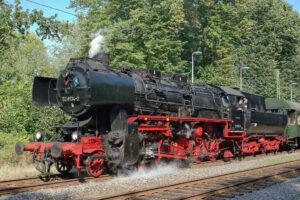
Steam engines offered a different way to drive work. The Thai source gives 1705 as a Newcomen invention date. The Science Museum account identifies the first practical Newcomen engine near Dudley Castle in 1712. This translation uses that better-supported milestone and distinguishes early pumping engines from later rotary machines.
Newcomen’s atmospheric engine did not simply produce modern high-pressure rotary power. Later engineering developments broadened the uses of steam. The important learning question is how energy reaches the moving parts, rather than assuming that all machines called steam engines operate in exactly the same way.
Waterwheels, factories and transport
The source argues that steam loosened industry’s dependence on the best waterwheel sites. This did not mean a factory could literally be placed anywhere: fuel, water, transport, workers and economic conditions still mattered. A new power source changes constraints rather than removing every constraint.
The story connects steam with factories, ships and railways. Those applications developed over time through many inventions and improvements. They show how an engineering idea can be adapted to different jobs; they were not all created at once by one inventor or one engine.
A question for a young inventor
The original author ends by connecting invention with wider effects on production and transport. Learners can ask what problem a mechanism solves and what other problems remain. A sketch explaining the source of motion, the transmission and the load is a useful way to discuss that relationship.
Keep this as a history and mechanism discussion. Boilers, steam pressure, hot surfaces and moving machinery need specialist controls; the article is not an instruction to build or run a working steam engine with children.
Original photographs and artwork
These images are retained from the original page as examples of published learning activities and programme information. Some contain Thai text or historical dates. They do not guarantee the same result for a new learner. Confirm current programmes with the team.
View original images


Frequently asked questions
Did Newcomen invent every use of steam in 1705?
No. The first practical Newcomen engine is associated with 1712, and steam technology developed through many earlier and later contributions.
Could steam-powered factories operate literally anywhere?
No. Steam changed location choices, but fuel, water, transport and other practical requirements still mattered.
Is this a steam-engine building activity?
No. It is a historical explanation and does not provide instructions for boilers or pressurised equipment.
Contact and related pages
Tell the team about the learner or organisation, relevant experience and the intended learning purpose. Confirm the current programme, equipment, availability, schedule and fees before booking.
Contact Raise Genius School service overview
- Offline Translator: The ili Device in the Archive
- Cleaner Energy: Sunlight, Wind and Water
- 2017 Study Advice: AI, Energy and Biosciences
- Vehicle Power: Electric, Hydrogen and Compressed-Air Ideas
- Steam Power: An Invention that Changed Machines
- Everyday Robots: Household Ideas from the Archive
- Future Robots: Four Examples from a 2016 Story
- Robot Construction: Ready-Made Toys and LEGO Kits
- Creative Robot Projects: Seven Student Ideas
Course-selection guide · Robotics portfolio projects · Competition preparation · Team advice and coaching · Course guide · General FAQ
Related services: School robotics camps · STEM activity stations
Related learning: Raise Maker Arduino · micro:bit robotics · IOTBot & AI · Portfolio preparation · Camp proposal · Accompanying teachers
Related reference: Science Museum: Newcomen engine · Hydropower basics
