
Seven Areas to Explore When You Want to Build a Robot
RAISE GENIUS · PARENTS & SCHOOLS
Seven Areas to Explore When You Want to Build a Robot
Preparing to build robots involves more than joining parts. The source introduces seven areas that can connect an idea with a model and a clear explanation.
Contact the teamOn this page
Preparing to build robots: ideas and quantities
Creativity is the first area: imagine a useful purpose, then ask what is feasible. The source mentions educational, medical, entertainment, space, agricultural and household robots as examples of different purposes.
Mathematics is second. A maker may need to think about movement, force, balance and the model’s own weight. A learning model is an opportunity to investigate these ideas, not proof of industrial or medical reliability.
Languages, physics and instructions
Third, another language can help a learner read and discuss work from other places. English, Chinese, German, Japanese and Korean are examples in the article, rather than a mandatory language list.
Fourth, basic physics can help explain forces and motion. Fifth, programming can express what a controllable robot should do under particular conditions. The source names C, C# and Python; these examples do not mean every mechanism must contain a computer or every learner must start with text-based code.
Explain an idea and revise an attempt
Sixth, presenting a model helps someone else understand its intended purpose and operation. A short explanation or demonstration can be adapted to the learner’s confidence and communication needs.
Seventh, allow for an attempt that does not work as intended. Inspecting, changing and trying again can be part of making. The archive’s point is persistence with support, not that disappointment must be ignored or that every project inevitably fails first.
Original photographs and artwork
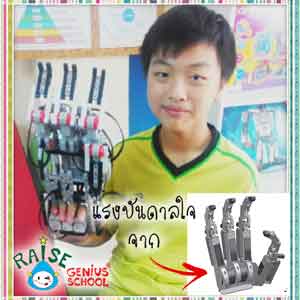
These images are retained from the original page as examples of published learning activities and programme information. Some contain Thai text or historical dates. They do not guarantee the same result for a new learner. Confirm current programmes with the team.
View original images


Frequently asked questions
Must a beginner already master all seven areas?
No. They are areas to explore through appropriate tasks and support.
Must every learner begin with Python or C#?
No. Choose the platform and level of instruction that suit the intended model and the learner.
Why explain an unfinished model?
Explaining what was intended and what happened can help a learner discuss the next change.
Contact and related pages
Tell the team about the learner or organisation, relevant experience and the intended learning purpose. Confirm the current programme, equipment, availability, schedule and fees before booking.
Contact Raise Genius School service overview
- How the Archive Describes Raise Genius School’s Approach
- Six Steps for Comparing a Child’s Holiday Camp Options
- Holiday or Weekend Robotics? Read the Archive’s Format Comparison
- Kind, Clear and Supportive Communication with Learners
- What Does Raise Genius Want Learners to Gain from a Team?
- Why the Founder Wanted Children to Build Robots
- Raise Genius Values: Make, Share and Take Part
- The Archive’s Path from Parts to Independent Challenges
- Fifteen Years of Making, Learning and Student Stories
Course-selection guide · Robotics portfolio projects · Competition preparation · Team advice and coaching · Course guide · General FAQ
Related services: School robotics camps · STEM activity stations
Related learning: Raise Maker Arduino · micro:bit robotics · IOTBot & AI · Portfolio preparation · Camp proposal · Accompanying teachers
Related reference: LEGO Education: hands-on learning


