
Moulding, Moving, Cooling and Packaging in an Archive Video
RAISE GENIUS · PARENTS & SCHOOLS
Moulding, Moving, Cooling and Packaging in an Archive Video
Chocolate factory process questions invite learners to spot automation in the original video. The article highlights four stages rather than a complete food-production specification.
Contact the teamOn this page
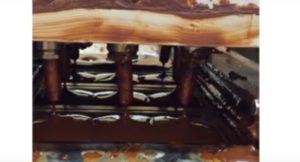
Chocolate factory process questions: depositing into a mould
The first example is placing liquid chocolate into a mould to form a repeatable shape. The source contrasts this with cutting each piece individually.
The intended lesson is that a machine can repeat a defined action. It does not follow that all chocolate products use the same recipe, forming process or equipment.
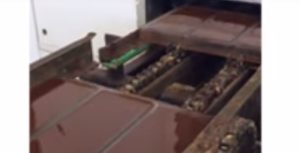
Second, move the product through the process
The article identifies a conveyor as a way to move items between stages. Learners who have used a small belt or track can recognise the broad idea of controlled movement.
An actual production line also needs guarding, hygiene, control and handling arrangements. A toy belt is not food-certified equipment, and a demonstration does not establish the speed or reliability of every factory.
Third, cool and remove; fourth, wrap
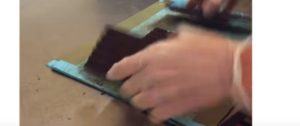
The source describes cooling chocolate until it holds its shape, then people removing it from the mould and observing its condition. It explains that delicate handling and inspection can make automation more complicated.
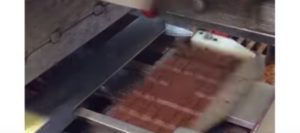
It then describes a machine wrapping similarly sized pieces. Those observations belong to the depicted line: they do not prove humans are always better at inspection, that machines cannot demould chocolate or that an entire factory requires only four devices.
Bring the sequence into a safe model
Chocolate factory process questions can be explored with clean model objects: what holds the shape, what moves, what is checked and what happens next? No heat or edible production is required to discuss the sequence.
The original video remains optional. A learning model can represent part of a process without guaranteeing that a child has designed a food-production system or reproduced every stage.
Original photographs and artwork
These images are retained from the original page as examples of published learning activities and programme information. Some contain Thai text or historical dates. They do not guarantee the same result for a new learner. Confirm current programmes with the team.
View original images
Original video archive
Choose a link to open the original video on YouTube. No external player, automatic playback or YouTube thumbnail is loaded here. The clips are retained from the published archive; their language, availability and content belong to the original upload.
Frequently asked questions
Are four stages a complete factory equipment list?
No. They are the examples highlighted in the archive.
Must every factory demould by hand?
No. The account describes a particular example.
Must a classroom model make edible chocolate?
No. Suitable clean model objects can illustrate the sequence.
Contact and related pages
Tell the team about the learner or organisation, relevant experience and the intended learning purpose. Confirm the current programme, equipment, availability, schedule and fees before booking.
Contact Raise Genius School service overview
- A Warm Invitation to Spend Time with a Caregiver
- Measuring a Physiological Response Does Not Directly Measure Truth
- Listen, Take Concerns Seriously and Connect with Appropriate Help
- Snake-Like Machines, a Piloted Robot and BigDog
- Moving a Dish, Coordinating a Route and Working with People
- P’Raise’s 2016 Look at Machining and Metal-Working Equipment
- Ask a Wider Question, Record Observations and Change the View
- An Uncrewed Aircraft Is More Than One Type of Toy
- Google’s 2016 Research Platform for Physical Programming
Course-selection guide · Robotics portfolio projects · Competition preparation · Team advice and coaching · Course guide · General FAQ
Related services: School robotics camps · STEM activity stations
Related learning: Raise Maker Arduino · micro:bit robotics · IOTBot & AI · Portfolio preparation · Camp proposal · Accompanying teachers
Related reference: NAEYC: developmentally appropriate practice
