
RAISE GENIUS · PARENTS & SCHOOLS
Entrepreneurial Maker Course: Automation & Presentation
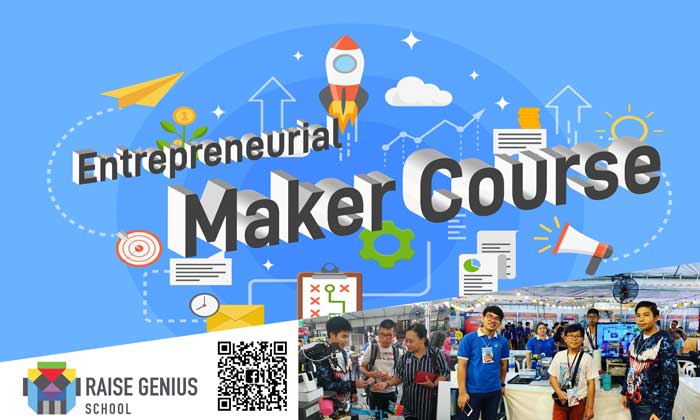
The Entrepreneurial Maker Course combines automation projects with the ability to explain an idea and show how it could solve a real problem. The published programme is for lower- and upper-secondary learners, with robotics, coding, electronics, design and presentation practice. Projects can also provide evidence of learning for a personal portfolio.
Contact the teamOn this page
Three stages of the Entrepreneurial Maker Course
Study: build a working foundation in electronic boards, programming and hardware. The aim is to understand enough to begin a project and continue researching independently, rather than copy an entire solution without understanding it.
Learning: investigate a problem and a possible opportunity to apply or communicate the resulting idea. Learners define their own project, build it and test it. Teachers guide, prompt and help resolve difficulties throughout the work.
Road show: when a suitable opportunity is available, learners develop and present their work in a public setting. The source describes sharing knowledge, inspiring others and addressing social problems. A specific exhibition, venue or commercial result is not promised.
What learners practise through a project
The programme connects identifying a problem, designing a response and presenting the idea to other people. Learners consider whether a proposed device has a practical use, and explain the reasoning behind their decisions.
Teamwork matters because a substantial technology project often needs several skills. Members learn to coordinate design, electronics, code and communication rather than expect one person to handle every part.
Experimentation is part of the learning process. An early mechanism or program may fail; learners practise patience, try changes and describe what the test shows. The intended progression runs from simpler robots and automation towards more demanding projects.
The source also emphasises confidence, independent inquiry, a constructive attitude towards innovation and the habits of a maker. Work may support future hobby, enterprise or competition projects. These are learning aims rather than guaranteed individual outcomes.
Equipment and programming in the published course
The published equipment examples include ESP and Arduino microcontrollers, Raspberry Pi boards, motors, sensors, electronic components, frames and cameras. Makeblock, Dobot and M5Stack are also listed. The source names C, Python and graphical programming as language options.
Some materials are provided by the school; some may be recommended for the learner to buy for convenient practice. Do not assume every listed platform is included in every project or that all hardware is included in a fee. Ask which equipment the agreed project actually requires.
Learners are expected to use a computer and the internet confidently and to have basic programming experience. A notebook computer is listed among the items to bring. Share previous projects and device details so the team can assess readiness.
Entrepreneurial Maker Course format and assessment
The source lists fourteen sessions of three hours each, once a week on Sunday at the Sathorn centre. It gives a morning session from 09:00 to 12:00 and an afternoon session from 13:00 to 16:00, with one to eight learners in a small group.
Project work is described as continuing over time, with regular attendance important for completing the build. Learners present their own or their team’s work near the end of a session for parents, and the project itself contributes to assessment.
The source describes teaching directed by a robotics master’s graduate from KMUTT’s FIBO, experienced robotics instructors, small-group questions and a pace responsive to the learner. It also records school history involving KMUTT incubation, NIA support and a DBD franchise standard. These remain attributed historical descriptions.
Confirm the currently offered location, teachers, session times, materials, fees and presentation opportunities before booking. A course project can document learning; university admission depends on each institution’s current requirements and assessment.
Original photographs and artwork
These images are retained from the original page as examples of published learning activities and programme information. Some contain Thai text or historical dates. They do not guarantee the same result for a new learner. Confirm current programmes with the team.
View original images
Frequently asked questions
Who is the Entrepreneurial Maker Course for?
The published course is aimed at lower- and upper-secondary learners who already use a computer and the internet confidently and have basic programming experience. Ask the team to assess readiness for the intended project.
How long is the published programme?
The source lists fourteen three-hour Sunday sessions at Sathorn, with 09:00–12:00 or 13:00–16:00 rounds and one to eight learners. Confirm the current timetable and availability.
Does a course portfolio guarantee admission?
No. It can record the learner’s project, experiments and presentation, but admission remains subject to the university’s current rules, academic requirements and selection process.
Must every learner buy every listed kit?
No such package is specified. The source says some equipment is supplied and some may be recommended for personal practice. Confirm the project-specific list and costs first.
Contact and related pages
Tell the team about the learner or organisation, relevant experience and the intended learning purpose. Confirm the current programme, equipment, availability, schedule and fees before booking.
Contact Raise Genius School service overview
- Online EV3 Programming Lessons: Original Video Archive
- LEGO Robotics for Kids: Build, Program & Present
- Scratch or Python for Kids: Choosing a Starting Point
- From Playing Games to Coding with Minecraft & Roblox
- Starting Coding and AI: An Age & Readiness Guide
- Learning Robotics When Maths Is Difficult
- Preparing a Robotics Engineering Portfolio
- Writing a School Robotics Camp Proposal
- Teacher Support for School STEM Activity Stations
Course-selection guide · Robotics portfolio projects · Competition preparation · Team advice and coaching · Course guide · General FAQ
Related services: School robotics camps · STEM activity stations
Related reference: School history: KMUTT UTO