
An Archive Comparison with Weekend Learning
RAISE GENIUS · PARENTS & SCHOOLS
An Archive Comparison with Weekend Learning
Robotics during school holidays is compared with other activities and weekend lessons in this archive. Its seven differences describe the programme offered at the time.
Contact the teamOn this page
Robotics during school holidays within a wider choice
The article recognises the planning involved in transport, costs, homework and the child’s wishes. It lists sport, travel, helping at home, cooking, craft, gardening, fish care, Go, chess, Sudoku and youth or science camps.
The original assigns some activities to boys or girls. This English edition opens every category to any interested learner. Making, movement and social experiences can all belong in a holiday; robotics is one option among them.
What the author sees in common with other activities
The source identifies useful leisure time, individual and group participation, enjoyment, thinking and movement as shared features. It then highlights learning together and helping peers within the school’s approach.
The archive also claims a balanced use of left and right brain hemispheres produces maximum efficiency. That popular explanation should not be treated as established evidence or a measured benefit of this course. Physical design, reasoning and creativity can be discussed without dividing learners by brain side.
The first three historical differences
First, holiday sessions were described as three hours compared with two hours for a weekend lesson, allowing more time to plan, build, test, revise and play with a model.
Second, meeting on consecutive days gave learners more shared time. Third, the author said fewer holiday groups left more construction pieces available than in the weekend arrangement. These are accounts of a particular offering, not commitments about current class size or equipment.
The remaining four historical differences
Fourth, the source described taking morning and afternoon sessions together, six hours in a day. Fifth, it expected faster continuity of practice from daily attendance. Sixth, it described more time to present and photograph work. Seventh, it said teachers could observe progress more conveniently.
None of these claims establishes that longer sessions suit every child or guarantee faster development. Confirm today’s schedule, breaks, teaching support and equipment. The learner’s willingness and comfort matter alongside a convenient transport plan.
Ask about the programme operating now
The author’s “four years” of teaching and the UTO/UBI relationship with King Mongkut’s University of Technology Thonburi belong to the historical account. They are not a fresh accreditation or endorsement check.
The original school video remains an optional link, and related pages provide a route to current enquiries. Compare robotics during school holidays with other suitable activities instead of assuming every day needs an organised course.
Original photographs and artwork
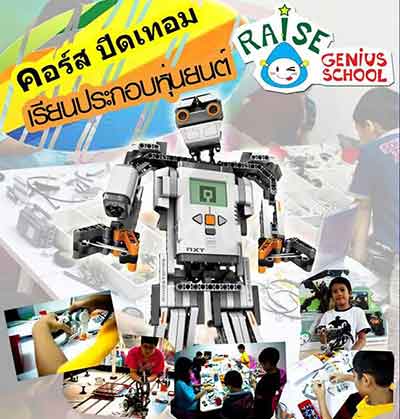
These images are retained from the original page as examples of published learning activities and programme information. Some contain Thai text or historical dates. They do not guarantee the same result for a new learner. Confirm current programmes with the team.
View original images


Original video archive
Choose a link to open the original video on YouTube. No external player, automatic playback or YouTube thumbnail is loaded here. The clips are retained from the published archive; their language, availability and content belong to the original upload.
Frequently asked questions
What session lengths did the archive compare?
Three-hour holiday sessions and two-hour weekend sessions.
Does a six-hour day suit every learner?
No. Confirm breaks, support and the learner’s needs before choosing.
Does robotics guarantee a balanced-brain benefit?
No. The older hemisphere explanation should not be read as evidence of a course outcome.
Contact and related pages
Tell the team about the learner or organisation, relevant experience and the intended learning purpose. Confirm the current programme, equipment, availability, schedule and fees before booking.
Contact Raise Genius School service overview
- Teacher Bung’s Memories and Ideas for a School Break
- Robotics, Cooking, Sport, Numbers, Languages and Clay
- Talking about Children’s Projects with Care
- Construction, Textures, Balance and Whole-Body Activity
- Building, Testing, Troubleshooting and Explaining
- Keeping Space for Conversation, Movement and Making
- Making “A Little Longer” Clear and Manageable
- Build a Set, Make a New Model and Tell a Story
- A Moral Dilemma as a Conversation, Not a Test
Course-selection guide · Robotics portfolio projects · Competition preparation · Team advice and coaching · Course guide · General FAQ
Related services: School robotics camps · STEM activity stations
Related learning: Raise Maker Arduino · micro:bit robotics · IOTBot & AI · Portfolio preparation · Camp proposal · Accompanying teachers
Related reference: NAEYC: developmentally appropriate practice · Nielsen et al.: the left-brain/right-brain hypothesis


