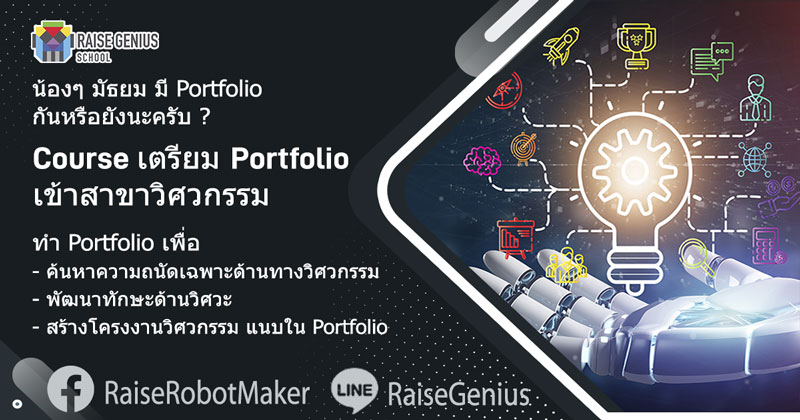
Preparing a Robotics Engineering Portfolio
RAISE GENIUS · PARENTS & SCHOOLS
Preparing a Robotics Engineering Portfolio
A robotics engineering portfolio can begin before the final school year, but a later start still calls for a focused discussion rather than an automatic rejection. The source proposes five useful elements: work the learner made, evidence of thinking, programming linked to hardware, relevant activities and a personal reason for choosing the field.
Contact the teamOn this page
Five robotics engineering portfolio essentials
1. A project with the learner’s own contribution. A kit can help someone start, but the learner should identify what they designed, coded or changed. A useful question is what would happen if a sensor failed and how they would investigate it.
2. Evidence of thinking. Keep early circuit sketches, unsuccessful tests, changes to sensor settings and short clips of an incomplete mechanism. A finished photograph gives less explanation than a record showing why the design changed.
3. Programming connected to hardware. The learner should explain how a command controls a motor or how a sensor reading affects the program. The source gives Arduino as an example; advanced syntax alone is not the purpose.
4. Relevant activities with an explained role. A camp, school club or supplementary course can provide experience. Describe the learner’s actual contribution and the problem they helped solve, rather than list participation without context.
5. A personal reason to study the field. Connect an interest in robotics to a specific project or problem and the knowledge the learner wants to develop. A statement of purpose should express the learner’s own reasons.
How a course can support a robotics engineering portfolio
The source says teaching can help build foundations for projects, process records, programming and related activities. A personal motivation and an honest interview explanation still need to come from the learner.
The article’s Maker example describes Arduino, C++ and IoT, with fourteen two-hour sessions. Its Entrepreneurial Maker example emphasises project design and presentation, Sunday teaching and small groups of no more than eight. Confirm the currently offered course and format.
The source refers to FIBO’s learning-by-doing curriculum as an example of practical engineering education. That curriculum description should not be treated as a universal admission rule or proof of what every selection committee will accept.
Published school stories mention Alpha’s ISE Chulalongkorn portfolio admission and a full scholarship, and Nat, Wasupon Hengsrithawat, entering KMUTT’s FIBO. These are attributed individual accounts. They do not predict another learner’s admission or scholarship outcome.
An age-stage plan for a robotics engineering portfolio
Around ages ten to fourteen, or late primary to early secondary, explore simple circuits, blocks and the normal experience of a robot failing a test. There is no need to turn every early activity into a polished application page.
Around ages fourteen to sixteen, begin a project with a question the learner helped define. Explore the differences between robotics, mechatronics and computer engineering so that later choices connect to actual interests.
In the penultimate secondary year, leave time for a main project and a record of its development. Starting early in the year allows more investigation before examinations and application deadlines become urgent.
If the learner begins in the final year, narrow the scope. One well-understood project with a clear question, difficulties and improvements may communicate more than several superficial builds. Check the actual deadlines and required evidence before deciding what can realistically be completed.
Three signs that the work can be explained clearly
The learner explains the project without reading a script, including the reason for a component choice. They can describe a failed attempt and what the next test changed. They can connect the project to a reason for studying the chosen field.
These observations help prepare an honest explanation; they do not certify an application as ready under every university’s rules. Check the current programme, academic criteria, required documents, page limits and interview arrangements with the institution.
Keep the learner’s role visible in team work. Distinguish personal design and code from a supplied kit, a teacher’s demonstration or another member’s contribution. Accurate evidence is more useful than making a project appear entirely independent when it was not.
Parents can help organise dates, photographs and files while leaving technical explanations and personal motivation to the learner. Ask open questions about a choice or a test, then let the learner show the evidence rather than memorise an adult’s answer.
Original photographs and artwork
These images are retained from the original page as examples of published learning activities and programme information. Some contain Thai text or historical dates. They do not guarantee the same result for a new learner. Confirm current programmes with the team.
View original images


Frequently asked questions
Can a robotics engineering portfolio start in the final year?
It may still be possible, depending on deadlines and current requirements. The source recommends narrowing the scope to one project with a complete explanation, alongside a personal statement and interview preparation.
Are competition certificates compulsory?
The article treats certificates as supporting evidence rather than a substitute for projects and thinking. Actual requirements vary: check the university’s current rules instead of assuming competitions are always required or always optional.
How does robotics differ from computer engineering?
The source emphasises robots’ integration of mechanisms, sensors, hardware and control code, while describing computer engineering through computing systems and software. Programmes overlap and vary; compare their actual curricula.
Can a learner with weaker maths prepare a portfolio?
They can begin practical work and document learning. Mathematics and physics foundations still matter, and every applicant must check and meet the programme’s current academic requirements.
Contact and related pages
Tell the team about the learner or organisation, relevant experience and the intended learning purpose. Confirm the current programme, equipment, availability, schedule and fees before booking.
Contact Raise Genius School service overview
- Entrepreneurial Maker Course: Automation & Presentation
- Online EV3 Programming Lessons: Original Video Archive
- LEGO Robotics for Kids: Build, Program & Present
- Scratch or Python for Kids: Choosing a Starting Point
- From Playing Games to Coding with Minecraft & Roblox
- Starting Coding and AI: An Age & Readiness Guide
- Learning Robotics When Maths Is Difficult
- Writing a School Robotics Camp Proposal
- Teacher Support for School STEM Activity Stations
Course-selection guide · Robotics portfolio projects · Competition preparation · Team advice and coaching · Course guide · General FAQ
Related services: School robotics camps · STEM activity stations
Related reference: FIBO undergraduate curriculum