
SCHOOL SERVICES · RAISE GENIUS
STEM Activity Stations for School Events
STEM activity stations let groups of pupils rotate through practical robotics challenges. Raise Genius brings robots, mission fields and teaching resources to school science days, academic events, open houses and STEM programmes, with activities adjusted to the learners.
Discuss your school’s plansOn this page
Three examples of STEM activity stations
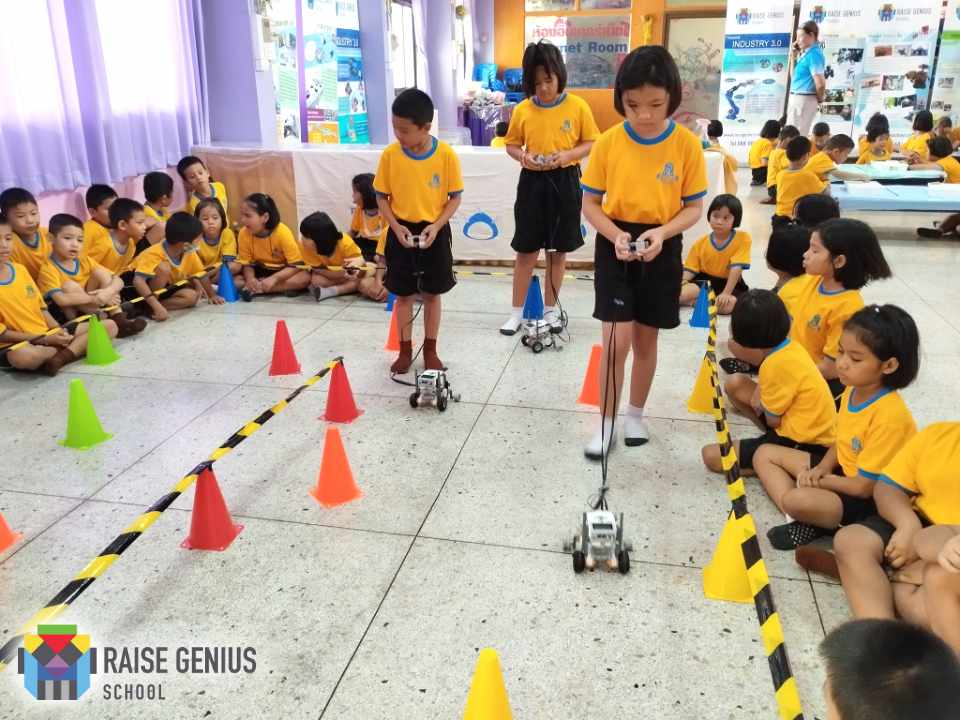
Robot driving through a mission field: pupils use a controller to guide a LEGO robot through cones and obstacles. The activity gives them an opportunity to plan a route, concentrate and practise precise control.
Sumo robots: pupils work with physical robot parts and decoration while exploring mechanisms and teamwork. The actual task and level of construction should be agreed for the pupils’ age and the time available.
Box-pushing missions: pupils control a robot to complete a task that invites logical thinking and cooperation. A simple challenge gives groups a shared goal and a reason to discuss what to try next.
These station examples come from the original service page. The final selection, robot kits and mission fields are planned with the school rather than promised as an identical package for every event.
How STEM activity stations rotate
The school divides pupils into groups that move between activities. Each station introduces a practical challenge with explanations from the activity team. This creates a structure for giving many pupils a chance to participate within the available time.
The published example describes groups of roughly forty to seventy pupils per station, rotating every ninety to one hundred and twenty minutes. It gives an indicative daily range of one hundred and twenty to three hundred pupils, with several consecutive days possible for a larger school.
These are planning examples, not an automatic capacity guarantee. The number of stations, staffing, equipment, age groups, participation time and room layout determine what can actually be provided. Agree the rotation plan with the school coordinator before confirming the event.
Planning STEM activity stations: age, time and preparation
The source describes activities for Kindergarten 2, Primary 1–6 and Secondary 1–3, with the content adapted to the age group. A full-day example is six hours, but the schedule can be discussed around the school’s science day or other programme.
Raise Genius prepares robot equipment, mission fields and teaching resources for the agreed stations. The school prepares a suitable venue and coordinates pupils and supporting teachers. Confirm power, space, movement between stations and supervision arrangements in advance.
The published service describes travel to schools in Bangkok, surrounding provinces and other regions of Thailand. Ask the team to confirm availability, travel arrangements and any related costs for the proposed location and date.
Experience, learning goals and booking steps
The source cites fifteen years of robotics and camp experience and names Anuban Ratchaburi, Daruna Ratchaburi and Wat Nang Sao among previous school activities. These are published historical references; photographs illustrate earlier events.
The activities aim to encourage teamwork, practical problem solving, creativity and interest in robotics and AI. They connect with STEM education and can inform a school’s learner-development activity report, with the actual learning objectives agreed for the event.
To begin, send the year groups, pupil numbers, preferred date and budget through the contact page. The team proposes activities and a quotation, then confirms the venue and rotation plan with the school. Discuss any event photographs and handover arrangements as part of that scope.
After an introductory event, a school can explore a continuing robotics subject, club, classroom setup, teacher training or a longer camp. Pupils interested in projects can also explore individual courses, without any guarantee of future admission or a particular portfolio result.
Published project photographs
These images are retained from the original service page as examples of previous work. Some contain Thai text or historical dates and prices. Confirm current equipment, availability and conditions with the team.
Frequently asked questions
How many pupils can join STEM activity stations?
The source describes groups from tens to hundreds of pupils, with an illustrative daily range of 120–300. The final capacity depends on stations, equipment, staffing, space and rotation time, and must be agreed for the school.
Which year groups are suitable?
The published age range covers Kindergarten 2, Primary 1–6 and Secondary 1–3. Activities and instructions should be adapted to the actual learners and supervision available.
How long does an event take?
A full-day example is six hours, or the programme can be adjusted around a science day, academic event or open house. Larger schools can discuss several consecutive days with the team.
What must the school prepare?
Prepare the venue, pupil groups and supporting teachers. Raise Genius supplies the robots, mission fields and teaching materials specified in the agreed plan. Confirm the final equipment and venue arrangements before the event.
Contact and related school services
Tell the team the school name, year groups, pupil or teacher numbers, preferred dates, location and budget. Agree the current content, equipment, fees, schedule and responsibilities in a written proposal before booking.
Contact Raise Genius School service overview
- School Robotics Curriculum & Classroom Setup
- Robotics Lessons for Schools: Curriculum & Timetables
- Minecraft Education for Schools: Coding Classrooms
- Microbit STEM for Schools: Robotics & Coding
- Robotics Teacher Training: STEAM Classroom Practice
- Robotics Camps for Schools: STEM Workshops
Teacher reference: IPST science and technology education resources (Thai).