From Peekaboo to Questions about Quantities
RAISE GENIUS · PARENTS & SCHOOLS
From Peekaboo to Questions about Quantities
Exploring how children think starts with noticing their explanations. This archive article uses peekaboo, modelling clay and a simple equation as discussion examples.
Contact the teamOn this page
Exploring how children think through everyday play
The original introduces differences in how children answer questions. It describes development as a sequence and suggests that a task could reveal a child’s “brain age”. That last interpretation should not be used: a brief activity is not a developmental assessment or an intelligence test.
The useful classroom question is what the learner currently notices, explains and can attempt with support. Experience, language, familiarity and the way an adult asks a question can all affect the response. Avoid comparing siblings or deciding that one unexpected answer defines a child.
Peekaboo and finding something that is hidden
The first example is peekaboo. A caregiver briefly hides a face and then reappears. The source connects the game with object permanence: understanding that something can still exist when it cannot be seen.
The archive labels its first period birth to two years. Use that as context for the older developmental discussion, not a rule that every infant believes every hidden object has vanished. Keep the game gentle, responsive and enjoyable.
Two equal pieces of clay can look different
The second example starts with two equal portions of modelling clay. One is rolled into a longer shape, and the adult asks which contains more. The changed appearance invites a discussion of conservation: the amount has not changed if nothing was added or removed.
The source discusses children aged roughly two to seven who may focus on length. Let a learner reshape, compare and explain rather than predicting that every four- or five-year-old must give the same wrong answer. The optional original video is retained separately.
An equation and a more abstract explanation
The third example asks: if A = 2 and A + B = 3, what is B? B = 1. Counters or a drawing can connect the symbols with a familiar quantity before asking for a verbal explanation.
The archive groups later thinking into ages seven to fifteen. Piaget’s framework distinguishes concrete operations from later formal reasoning; it does not make one equation a reliable test of readiness for programming. Choose a next task from what the learner demonstrates, with patient support.
Original photographs and artwork
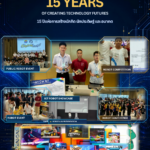
These images are retained from the original page as examples of published learning activities and programme information. Some contain Thai text or historical dates. They do not guarantee the same result for a new learner. Confirm current programmes with the team.
View original images


Original video archive
Choose a link to open the original video on YouTube. No external player, automatic playback or YouTube thumbnail is loaded here. The clips are retained from the published archive; their language, availability and content belong to the original upload.
Frequently asked questions
Does a clay question measure brain age?
No. It is an informal discussion example, not a developmental or intelligence assessment.
Why change the shape of the clay?
It helps discuss the difference between appearance and the quantity of material.
Must a child solve equations before trying coding?
No. Use tasks and instructions suited to their experience and support needs.
Contact and related pages
Tell the team about the learner or organisation, relevant experience and the intended learning purpose. Confirm the current programme, equipment, availability, schedule and fees before booking.
Contact Raise Genius School service overview
- A Guide to the Archive’s Discussion of Cognitive Development
- How a Different Question Can Change a Robot Project
- Small Ideas, Mechanisms and Creative Construction
- Questions, Confidence and Manageable Challenges
- Thinking, Design, Hand Use and Sharing a Creation
- Exploring a Child’s Learning Strengths
- Discovering Children’s Interests without Pressure
- Teacher Bung on Connecting Learning at School and Home
- A Short Classroom Reflection on Learning Together
Course-selection guide · Robotics portfolio projects · Competition preparation · Team advice and coaching · Course guide · General FAQ
Related services: School robotics camps · STEM activity stations
Related learning: Raise Maker Arduino · micro:bit robotics · IOTBot & AI · Portfolio preparation · Camp proposal · Accompanying teachers
Related reference: Fondation Jean Piaget: the development of thought · NAEYC: developmentally appropriate practice