
Use a Long Break to Play, Build and Talk Together
RAISE GENIUS · PARENTS & SCHOOLS
Use a Long Break to Play, Build and Talk Together
Family activities during long breaks can be as simple as making something together at home. The archive contrasts busy holiday travel and queues with shared play, visits to relatives and time to enjoy being together.
Contact the teamOn this page
Family activities during long breaks can be open-ended
The source’s examples are modelling clay, drawing and LEGO. It values materials that allow a beginner and a more experienced maker to produce different things from the same starting resources.
An activity does not need a prescribed correct model to be interesting. Ask what the child would like to create and leave room for the idea to change. Choose suitable materials for the children involved and follow product instructions.
Three things the source invites adults to notice
First, spatial choices: a learner may compare lengths, turn a piece or arrange parts into a form. The archive uses cars and aircraft when discussing how parts are placed on either side of a model.
Second, imagination: ask what a piece is meant to represent and which features the learner wants to include. A simple piece can stand for an elaborate idea; greater visual detail is not automatically greater creativity.
Third, planning: discuss where the learner started, what needed changing and what they might try next. The original suggests that smooth building proves a complete plan existed mentally, but that conclusion does not follow from the finished model alone.
Keep observation as a conversation, not an assessment
The article’s observations can help an adult ask about a child’s work. They are not a validated developmental scale, intelligence test or method for diagnosing a difficulty.
A symmetrical model is not required to show spatial understanding, and rebuilding is not proof of poor planning. Experimenting and revising can be part of a thoughtful approach. A child may prefer to explain the story rather than construct a realistic object.
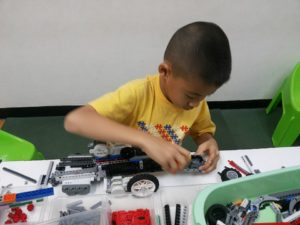
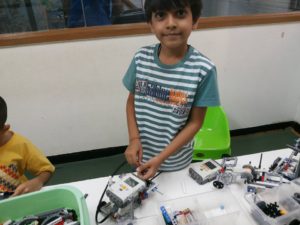
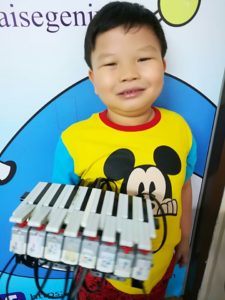
The archive includes photographs of children’s construction activities, retained in the gallery. Its central invitation is to spend time together, enjoy making and learn something about the child’s ideas. It does not require booking a class or achieving a measurable result during the holiday.
Original photographs and artwork
These images are retained from the original page as examples of published learning activities and programme information. Some contain Thai text or historical dates. They do not guarantee the same result for a new learner. Confirm current programmes with the team.
View original images
Frequently asked questions
Are these observations a developmental test?
No. They are conversation prompts from the archive, not a validated assessment or a way to diagnose a child.
Does rebuilding mean the child planned badly?
No. Trying and revising can be part of exploring a design; the result alone cannot reveal the learner’s whole thinking process.
Must a model be realistic or symmetrical?
No. Ask what the child intends the pieces to represent rather than judging ability from visual detail or symmetry.
Contact and related pages
Tell the team about the learner or organisation, relevant experience and the intended learning purpose. Confirm the current programme, equipment, availability, schedule and fees before booking.
Contact Raise Genius School service overview
- Explore Technology Learning beyond the Classroom
- Primary School Readiness: Leave Room for Play and Confidence
- Raise Robot Workshop 12 at TK Park: An Archive Introduction
- School Readiness and Play: Read International Comparisons Carefully
- Plan a School Holiday with Exploration, Rest and Making
- Language Practice: Make Room for Conversation and Shared Play
- What Is EF? Discuss Executive Function through Everyday Play
- Choose Holiday Activities That Let Children Try Their Interests
- What Can Learners Practise When Building Robots?
Course-selection guide · Robotics portfolio projects · Competition preparation · Team advice and coaching · Course guide · General FAQ
Related services: School robotics camps · STEM activity stations
Related learning: Raise Maker Arduino · micro:bit robotics · IOTBot & AI · Portfolio preparation · Camp proposal · Accompanying teachers
Related reference: NAEYC: developmentally appropriate practice
