
Teacher Bung’s Memories and Ideas for a School Break
RAISE GENIUS · PARENTS & SCHOOLS
Teacher Bung’s Memories and Ideas for a School Break
Holiday skill activities can leave room for rest, shared time and new experiences. Teacher Bung’s archive combines family reflections with camp and community examples.
Contact the teamOn this page
Holiday skill activities after a demanding school term
The source begins with the pressure before examinations. Families may arrange extra lessons while also balancing work and travel, then discover that the child still has substantial homework at home. Teacher Bung recognises that parents cannot always explain every subject in the way it is taught at school.
Her suggestion is to make a little room for a warm shared activity, even when another academic lesson is not practical. Art or making something together are examples. A smile, a conversation and time with a caregiver can be part of the day without adding another test or expecting a perfect finished product.
After examinations, the author sees the school break as an opportunity for experiences that do not fit easily into the normal timetable. Playing, travelling, resting, joining a camp and trying a skill are among the possibilities. Holiday skill activities should be considered alongside a child’s wishes and the family’s circumstances.
A personal memory of being at home
Teacher Bung recalls sleeping later, watching cartoons, having snacks and being free from the school schedule. The strongest memory in her account is having a whole day with her mother. This is the author’s childhood experience, rather than a claim that every family has the same preferences or can spend the holiday in the same way.
The point is that a useful break does not have to be filled from morning until evening with paid classes. Ask what would make time together enjoyable and manageable. A short familiar activity can matter just as much as a new destination when the adult is able to take part attentively.
A week at a YMCA camp
The archive describes a YMCA camp outside the city when Teacher Bung was a little over ten. She remembers making friends beyond her school and meeting children with different experiences and opportunities. Learning to ride a bicycle is one event she particularly recalls.
Other memories include archery, an organised tower activity, boating, pitching and packing a seaside tent, looking after personal belongings and a farewell campfire. The camp leaders encouraged participants to do things for themselves. These are details of a historical personal account, not an advertisement for a currently available camp or a recommendation to attempt those activities without qualified supervision.
For a present-day camp, a family would need to confirm the organiser, supervision, emergency arrangements, suitability, accessibility and the child’s willingness to attend. The older article’s description of looking after pocket money does not remove an organiser’s responsibility to explain the arrangements clearly.
A swimming memory needs a safety distinction
Teacher Bung also recalls travelling from the Suksawat area to swimming lessons at the National Stadium while in early secondary school. The source describes a deep pool normally associated with diving and a demanding learning experience.
This is retained as a memory, not an instruction to place a beginner in deep water or travel independently. Holiday skill activities involving water require suitable teaching, close supervision and an appropriate environment. The archive’s light-hearted suggestion that a non-swimmer must manage alone should not be followed.
More choices became visible through the internet
The article then moves to a wider range of organised activities: cooking, clay work, bead work, language learning and making robots. The author values experiences that a child can use beyond a mark on a school test.
This does not mean a camp guarantees independence in every difficult situation. A useful conversation is what the activity actually lets the learner do: follow steps, handle materials, communicate, make a decision or revise an attempt. Ask how support is provided when a task is unfamiliar.
When comparing holiday skill activities, consider the journey, session length, breaks, costs and the amount of choice available to the learner. A new skill should not require treating a tired child as uncooperative or a family’s budget as a measure of commitment.
Community examples in the original article
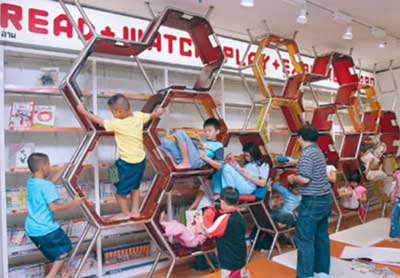
The source names TK Park at CentralWorld and the Bangkok children’s museums at Chatuchak and Thung Khru. Teacher Bung also recalls taking children to free robot-making workshops at TK Park.
The archive describes reading spaces and exhibitions involving science, art and making, and says some activities were free. Those statements belong to the original article. This translation does not confirm current opening hours, floor locations, admission conditions, prices or workshop availability. Check the relevant organiser before a visit.
The broader idea is to consider libraries, museums and community opportunities as well as commercial courses. A simple activity at home can also be suitable. The best option for a particular family depends on access, interest and the actual arrangements.
Eight questions to discuss before choosing
What does the child want to try? What would they actually do during a session? How long is the journey? What support and supervision are provided? These four questions translate the archive’s emphasis on enjoyment and participation into a practical conversation.
What will the complete cost be? Are breaks and rest included? How will an adult and learner discuss the experience afterwards? What is the alternative if the activity does not suit the learner? These additional questions are planning prompts in this English edition, rather than a quoted checklist from the original.
Use the answers to choose a manageable experiment rather than promise a permanent talent. Related links lead to school and family services where current details can be requested. No place, fee or timetable is confirmed by reading this historical article.
Original photographs and artwork
These images are retained from the original page as examples of published learning activities and programme information. Some contain Thai text or historical dates. They do not guarantee the same result for a new learner. Confirm current programmes with the team.
View original images


Frequently asked questions
Must a useful holiday be filled with paid lessons?
No. The source values rest, family time and community opportunities as well as camps.
Are the YMCA and swimming accounts current booking advice?
No. They are Teacher Bung’s personal memories and need a clear safety distinction.
Are the listed museum fees and locations confirmed for today?
No. Check current information with the organiser.
What is the main planning priority?
Find a manageable experience suited to the learner, with clear support and arrangements.
Contact and related pages
Tell the team about the learner or organisation, relevant experience and the intended learning purpose. Confirm the current programme, equipment, availability, schedule and fees before booking.
Contact Raise Genius School service overview
- Robotics, Cooking, Sport, Numbers, Languages and Clay
- An Archive Comparison with Weekend Learning
- Talking about Children’s Projects with Care
- Construction, Textures, Balance and Whole-Body Activity
- Building, Testing, Troubleshooting and Explaining
- Keeping Space for Conversation, Movement and Making
- Making “A Little Longer” Clear and Manageable
- Build a Set, Make a New Model and Tell a Story
- A Moral Dilemma as a Conversation, Not a Test
Course-selection guide · Robotics portfolio projects · Competition preparation · Team advice and coaching · Course guide · General FAQ
Related services: School robotics camps · STEM activity stations
Related learning: Raise Maker Arduino · micro:bit robotics · IOTBot & AI · Portfolio preparation · Camp proposal · Accompanying teachers
Related reference: NAEYC: developmentally appropriate practice


