
Teacher Num on Work, Technology and Changing Possibilities
RAISE GENIUS · PARENTS & SCHOOLS
Teacher Num on Work, Technology and Changing Possibilities
Discussing future careers is harder when the work itself changes. Teacher Num’s archive offers examples to explore with learners rather than a reliable employment forecast.
Contact the teamOn this page
Discussing future careers without a fixed prediction
The article contrasts asking “What do you want to be?” with asking how a job might change. Its forecast refers to five to ten years after the original publication, not a new five-to-ten-year prediction starting today.
The author expects creative work, collaboration and technology to become more closely connected, while routine tasks may be automated. These are the author’s expectations. They do not establish that every routine job will disappear or that a named occupation is safe from change.
Examples of tasks already changing in the archive
The source describes a field reporter using a smartphone rather than a large separate camera arrangement, a teacher using image processing to help mark answer sheets, and speech recognition converting an interview into text.
These examples concern tasks and tools. A smaller device does not remove every technical role, and an automated transcript or marked answer sheet can still require review. Ask what the technology does, who checks it and what happens when it is wrong.
Connected bins and more targeted farming
The article imagines sensors reporting how full a rubbish bin is so collection staff can plan a route. It also describes data helping a farmer decide where and when water or fertiliser is needed.
It links those ideas with AI, IoT and 5G. Treat the descriptions as possible system designs rather than claims that each deployment needs 5G or automatically cuts costs and improves yields. Data quality, maintenance, connectivity and practical conditions matter.
Four occupations used as conversation examples
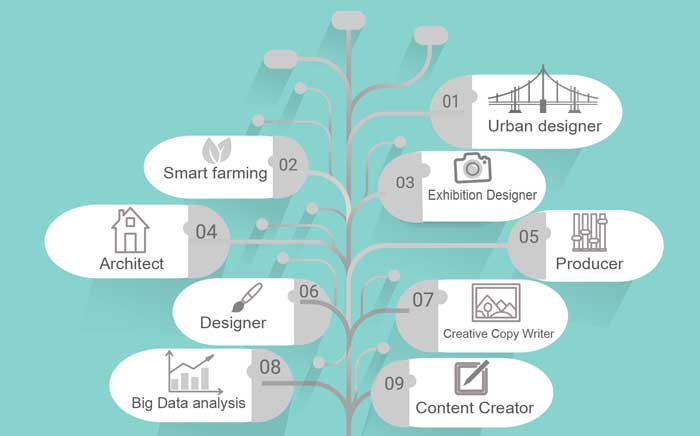
First, an urban designer could use virtual representations and data to compare a plan. Second, a farmer could combine sensor information with decisions about growing conditions.
Third, an exhibition designer could use augmented reality to add a story or explanation. Fourth, an architect could explore a virtual representation before construction. The source’s “first time” wording is not repeated as a historical claim about architectural visualisation.
These four examples connect familiar purposes with a technical tool. They are prompts for discussing future careers, not a current list of vacancies, salaries, admission requirements or guaranteed career paths.
Keep curiosity wider than one job title
Teacher Num recognises that parents’ own experience may not map neatly onto a child’s future. A learner can explore an interest, explain a small design and notice how another person would use it without choosing a permanent occupation.
Ask about the intended user, information needed, a possible failure and what a person still decides. Related learning links offer ways to explore those questions, without promising that one course secures employment.
Original photographs and artwork
These images are retained from the original page as examples of published learning activities and programme information. Some contain Thai text or historical dates. They do not guarantee the same result for a new learner. Confirm current programmes with the team.
View original images


Frequently asked questions
Does the article predict which jobs will certainly disappear?
No. It offers the author’s historical expectations and examples.
Must an IoT example use 5G?
No. The communication design depends on the actual application.
Does choosing robotics guarantee a future job?
No. A learning activity can support exploration without guaranteeing employment.
Contact and related pages
Tell the team about the learner or organisation, relevant experience and the intended learning purpose. Confirm the current programme, equipment, availability, schedule and fees before booking.
Contact Raise Genius School service overview
- Observe, Test and Adapt an Idea with Support
- Research, Social Robots, Electronics and Useful Machines
- Cleaning, Cooking and Folding as Design Questions
- Bitcoin, AlphaGo and a Child’s First Design Ideas
- Technology Interest, School Workload and Playful Learning
- Keep the Activities, Clarify the Brain-Side Claim
- Collaboration across Thai Universities and Institutes
- A Small Robot, Coloured Paths and Planning
- AlphaGo, OpenAI’s Dota Bot and What a Result Means
Course-selection guide · Robotics portfolio projects · Competition preparation · Team advice and coaching · Course guide · General FAQ
Related services: School robotics camps · STEM activity stations
Related learning: Raise Maker Arduino · micro:bit robotics · IOTBot & AI · Portfolio preparation · Camp proposal · Accompanying teachers
Related reference: NAEYC: developmentally appropriate practice
