Choosing Robotics Teacher Training for Your School
RAISE GENIUS · PARENTS & SCHOOLS
Choosing Robotics Teacher Training for Your School
Choosing robotics teacher training should focus on what school teachers can do after the event. The source emphasises actual classroom experience, reusable lessons and support during real teaching, rather than a demonstration that ends when the visiting team leaves.
Contact the teamOn this page
Five checks for choosing robotics teacher training
1. Experience teaching children. Ask which age groups the trainers have taught and how they handle classroom problems, rather than looking only at equipment sales.
2. Materials teachers can reuse. Confirm lesson plans, slides or manuals that can support the next lesson.
3. Follow-up contact. Ask where a teacher can seek help when a problem appears during the following term, and what support is included.
4. Fit to the school’s year groups. A primary-only school and a school with lower secondary need different depth and progression.
5. Clear commercial scope. Separate training, kits and continuing support in the proposal so the school knows what is included. These are enquiry checks, not a claim about a particular vendor’s current contract.
Match training to the pupils and teachers
For Years 1-3, the source favours simple structures and hands-on STEM projects, with games and group activities rather than a purely theoretical presentation.
For Years 4-9, it describes fuller construction/programming projects and practice with common problems such as a loose connection or a sensor reading that does not match expectations.
Teachers who lack a computer-specialist background need a programme genuinely designed for beginners, including time to try tasks themselves. Watching a trainer succeed is not the same as practising independently.
Warning signs of a demonstration without teaching transfer
Teachers cannot describe what they will teach next; they receive no plans or usable materials; demonstration equipment differs from the school’s actual kit; or the team cannot be reached afterwards.
Use these signs as reasons to clarify a proposal before committing. The source recommends at least two-three days for its intended teacher-preparation aims, rather than assuming any single demonstration day establishes teaching confidence.
Training time alone is not a universal measure of effectiveness. Ask what teachers practise, what they take away and how they will be supported with their actual equipment.
School experience and practical next questions
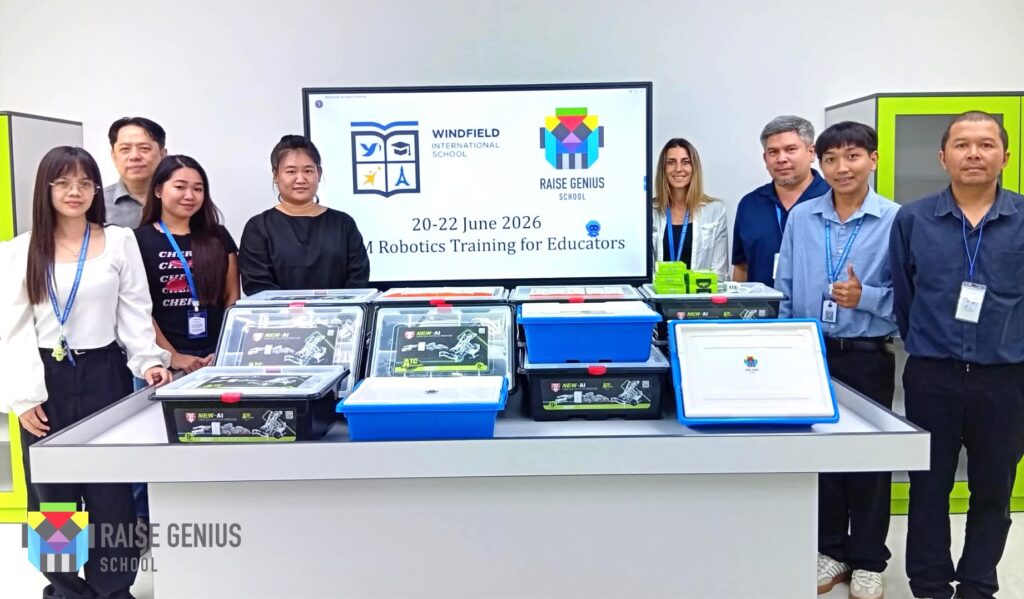
The source describes fifteen years of school experience, UBI/KMUTT incubation and work with Windfield International School in Samui and Chiang Mai. These remain attributed school accounts, not newly verified client endorsements.
It says the school provides plans used with children for teachers to adapt. Confirm the actual materials, trainers, dates and follow-up in the proposed arrangement.
The source recommends pairing training with equipment teachers can continue using. If the school already has suitable kits, discuss how training will use them rather than assume a second purchase is universally compulsory.
When choosing robotics teacher training, explain year groups, existing hardware, teacher experience, timetable and goals. Link the proposal to a curriculum or club that can continue after the training.
Original photographs and artwork
These images are retained from the original page as examples of published learning activities and programme information. Some contain Thai text or historical dates. They do not guarantee the same result for a new learner. Confirm current programmes with the team.
View original images

Frequently asked questions
Is one training day enough?
The source recommends at least two-three days for teachers to practise classroom processes and build confidence for its intended programme. Confirm the actual tasks, teacher readiness and follow-up rather than judging a course only by duration.
Can a teacher without a computing background learn to teach robotics?
The source says beginner-oriented training can help, particularly when teachers practise hands-on instead of only watching. Ask how the programme supports their current experience and equipment.
Must training and new kits always be purchased together?
The source recommends combining training with kits available for continued practice. Confirm the proposed package and whether existing school equipment is suitable; the article does not establish a universal rule requiring a second purchase.
Contact and related pages
Tell the team about the learner or organisation, relevant experience and the intended learning purpose. Confirm the current programme, equipment, availability, schedule and fees before booking.
Contact Raise Genius School service overview
- Computer Specs for Children’s Coding Lessons
- How Much Parent Support Does Online Coding Need?
- Choosing Online Coding for Kids by Age & Readiness
- Online Robotics Learning When No Class Is Nearby
- Robotics for Small Schools with Limited Budgets
- Planning School STEM Robotics Camps & Budgets
- Starting a School Robotics Classroom: People Before Kits
- Primary Computing Lessons: From Mechanisms to Code
- Helping a Child Become a Programmer: Build Foundations
Course-selection guide · Robotics portfolio projects · Competition preparation · Team advice and coaching · Course guide · General FAQ
Related services: School robotics camps · STEM activity stations
Related reference: IPST computing-education resources (Thai)