
RAISE GENIUS · STUDENT WORK
Student Robotics Projects & Presentations
Student robotics projects turn an idea into a model that can be built, tested and explained. This archive presents nine LEGO robotics examples, alongside student presentations and media coverage. The original introduction also includes Arduino, Raspberry Pi and wider Maker work; the detailed cases below focus on the recorded LEGO projects.
Contact the teamOn this page
Learning through student robotics projects
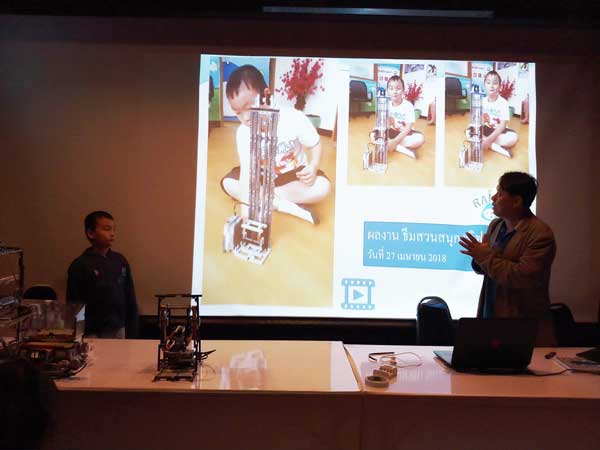
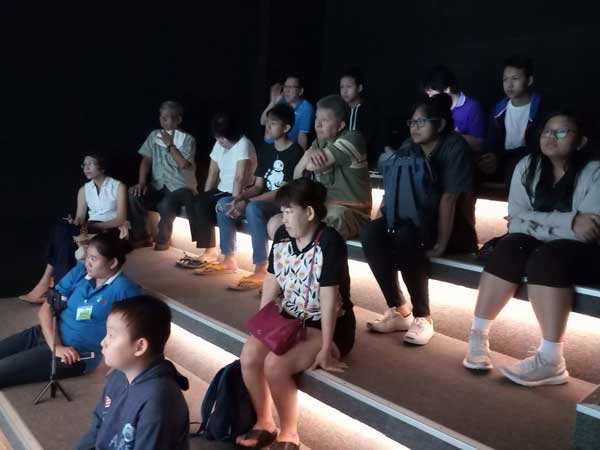
The first Raise Genius showcase at Bangkok City Library gave pupils a place to present their work and learning progress to parents, other pupils and visitors. The original account connects the event with the library’s first-anniversary activities.
The school’s approach encourages pupils to identify an interest, investigate ideas, design, build, test, solve problems, make decisions and present the result. Sharing work with an audience gives learners a reason to explain what they tried and how their model behaves.
The source emphasises soft skills alongside robotics and automation knowledge: practical thinking, research, communication and working with others. The following student robotics projects are examples from earlier pupils, rather than standard outcomes promised to every new learner.
Project durations, levels, ages and kit names are historical record fields. They are not current course packages, independent certifications or guarantees of the time another pupil will need.
1. Great Ball Contraption: a complete-loop ball conveyor
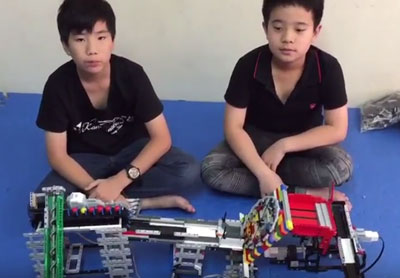
Tae and Tonnam built a Great Ball Contraption that moves balls around a complete loop through several mechanisms. The source records fifteen hours of project work, LEGO MINDSTORMS EV3, an advanced-mechanics level and basic programming.
The mechanism notes include chains, rotating elements and levers. The account highlights concentration, systematic thinking, physical principles, problem solving and teamwork, together with the process of exploring an idea and preparing it for presentation.
The original profile describes Tonnam as having learned from early childhood and Tae as enjoying unusual, challenging inventions. Those are pupil descriptions at the time of publication, not statements of their current ages or learning status.
2. Automation conveyor: changing the direction of movement
Chida created a conveyor model that moves objects from a higher position towards a lower one and allows the movement direction to be changed. The source records three hours, an Imagine level and an EV3-family kit.
The mechanical notes identify chains and gears and record no programming for this example. The pupil account emphasises calm concentration and solving difficulties during construction. This project shows that an interesting mechanism can be investigated without assuming that every build requires a complex program.
3. Three-axis CNC-inspired robot model
Phukhao built a model with motion along the X, Y and Z axes and rotation around the Z axis, inspired by an industrial CNC machine. The source records nine hours of work with LEGO MINDSTORMS NXT 2.0.
The recorded kinematic arrangement is a gantry robot, with remote-block programming. The account highlights patience and repeated problem solving during construction. This is a classroom model inspired by a machine, not a claim that the project is an industrial machining product.
4. A keyboard-playing robot
The source describes a robot that moves to strike keyboard keys and play music. It records twelve hours of work, an advanced-programming level and LEGO MINDSTORMS NXT 2.0.
The notes identify revolute-joint motion, balance and timing/phase control. The idea illustrates how coordinated movement and a program’s timing can be investigated through music. No inventor name is assigned here where the project record does not clearly provide one.
5. A parallel-mechanism drawing robot
Phukhao’s drawing robot moves through a parallel mechanism driven from the robot’s shoulder positions. The source records six hours and LEGO MINDSTORMS NXT 2.0.
The mechanism notes list chains, gearboxes and a truss structure. The source connects the idea with an industrial parallel robot and a possible two-dimensional routing concept. The pupil account describes an interest in mechanisms, computing and engineering, with a willingness to build independently and tackle more demanding tasks.
6. An imaginary insect-eating flower
Pikul’s flower model uses one LEGO motor to move six universal joints together, creating motion that resembles petals. The recorded project time is two hours, using LEGO MINDSTORMS NXT 2.0.
The source records no programming for this build and emphasises imagination, creativity and the confidence to explain an idea. The pupil’s age in the original profile belongs to that earlier account; it is not a current age statement or a minimum age for every similar project.
7. An exoskeleton-inspired linkage model
Nano created an exoskeleton-inspired model whose arm can move up and down through a small wrist movement and a parallel-linkage arrangement. The source records three hours and identifies gears and bars as mechanism elements.
The idea references Iron Man and is described as an opportunity to explore imagination, inspiration and basic physical principles. The account also mentions presenting a robot on stage at TK Park, CentralWorld. Hardware details not clearly stated in that project record are not added here.
8. A doughnut-machine model
Jap’s LEGO model represents an automatic doughnut conveyor that can turn the doughnut model to expose both sides. The inspiration came from seeing a machine at Central Rama II.
The source records a Thinking level, conveyor research, linear and rotary motion, belts, levers and time-synchronisation blocks. It does not give a project duration for this case. The pupil account recognises creativity, confident expression and support from family and Roong Aroon School.
9. A crank-driven humanoid
Copter built a humanoid with a complex structure and a crank mechanism for walking. The source records four and a half hours of work in one session and a Raise Thinking level.
The account highlights persistence and practical use of different parts, with gears among the mechanism notes. The original programming field contains the notation Net If; the exact code is not reconstructed or presented as a verified technical implementation here. The source describes an interest in mechanisms encouraged by family experiences.
More student presentations and media stories
The archive includes presentation clips featuring Phum, Nano’s Little Dog, Hadit’s walking mechanism and lighting, Yu’s soap-production model, Pan’s dinosaur-fossil idea, Q’s exploration robot, Copter’s cuckoo clock and Tonnam’s space-themed project.
These clips add examples of pupils explaining an idea and demonstrating a mechanism. Names are transliterated from the Thai source and should be checked against the school’s preferred spellings before new publicity.
Media accounts include CeeMeAgain with NIA, GoodMoodGoodFood with Ploy Horwang, a Thai PBS segment dated 24 October 2018, Weekend Life Kids on Channel 3 Family, Wisdom World and Phuean Khu Khit. They are historical coverage of the institute and its learning approach, not current broadcasting or sponsorship commitments.
Video links below open the original YouTube pages only when selected. No third-party player, automatic playback or YouTube thumbnail is loaded by this English page. The institution profile also records earlier NIA, KMUTT incubator and franchise-development background, which is distinct from the pupils’ individual project work.
Discuss a learning pathway through student robotics projects
The nine student robotics projects show different interests: moving objects, manufacturing models, music, drawing, imaginary creatures and walking mechanisms. A pupil’s next step should be chosen around age, readiness, interests and the equipment actually available.
Use the English course guide or project-portfolio page to discuss possible pathways with the team. If the aim is a competition, ask about the preparation or coaching service and check current event rules separately from these historical examples.
These student robotics projects do not promise a fixed build time, an award or university admission. The purpose of the archive is to share earlier learning experiences and invite questions about an appropriate current programme.
Original photographs and artwork
These images are retained from the original page as examples of previous student work and published school history. Some contain Thai text or historical dates. They do not guarantee the same result for a new learner. Confirm current programmes with the team.
View original images



Original video archive
Choose a link to open the original video on YouTube. No external player, automatic playback or YouTube thumbnail is loaded here. The clips are retained from the published archive; their language, availability and content belong to the original upload.
- Original project or media video 1 (YouTube)
- Original project or media video 2 (YouTube)
- Original project or media video 3 (YouTube)
- Original project or media video 4 (YouTube)
- Original project or media video 5 (YouTube)
- Original project or media video 6 (YouTube)
- Original project or media video 7 (YouTube)
- Original project or media video 8 (YouTube)
- Original project or media video 9 (YouTube)
- Original project or media video 10 (YouTube)
- Original project or media video 11 (YouTube)
- Original project or media video 12 (YouTube)
- Original project or media video 13 (YouTube)
- Original project or media video 14 (YouTube)
- Original project or media video 15 (YouTube)
- Original project or media video 16 (YouTube)
- Original project or media video 17 (YouTube)
- Original project or media video 18 (YouTube)
- Original project or media video 19 (YouTube)
- Original project or media video 20 (YouTube)
- Original project or media video 21 (YouTube)
- Original project or media video 22 (YouTube)
Frequently asked questions
Are these student robotics projects standard course outcomes?
They are examples from earlier pupils, not a guaranteed project list for every course or learner. Discuss the pupil’s interests, experience, readiness and current programme with the team.
Does the recorded project time apply to a new pupil?
No. The hours describe the original project account. Another learner may need a different amount of time, support or a different activity. The archive does not promise the same result in the same duration.
Are NXT and EV3 the only platforms taught?
The original introduction also names Arduino, Raspberry Pi and Maker work. The nine detailed archive examples focus on LEGO kits. Confirm currently supported hardware and software for the course being considered.
What can pupils practise besides construction and coding?
The source highlights investigating ideas, testing, problem solving, concentration, teamwork and presenting a result. The balance depends on the project and the learner’s stage.
Why are videos shown as links?
The links let readers choose to open the original YouTube page. Embedded players, automatic playback and externally loaded thumbnails are not used in this English staging page.
Does completing a project guarantee an award or admission?
No. Projects can document a learner’s experience and development, but competitions and admissions have their own requirements and decisions. Confirm current requirements with the relevant organiser or institution.
Contact and related pages
Tell the team the learner’s age, interests, experience and what they want to explore next. Discuss a suitable current programme and confirm its content, equipment, availability and fees before enrolling.
Contact Raise Genius School service overview
Robotics portfolio projects · Competition preparation · Team advice and coaching · Course guide · General FAQ
Educational reference: IPST science and technology education resources (Thai).