A Short Classroom Reflection on Learning Together
RAISE GENIUS · PARENTS & SCHOOLS
A Short Classroom Reflection on Learning Together
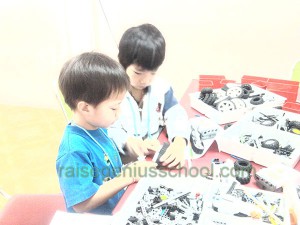
Helping peers through construction is the focus of this short archive reflection. P’Raise describes one learner showing another how to continue a model.
Contact the teamOn this page
Helping peers through construction in the original photograph
The Thai source identifies Ton Nam helping Eugen. It presents the moment as an example of children learning together at Raise Genius, rather than a measured study of social development.
The author values helping, playing together and allowing room for mistakes. Both the learner explaining and the learner receiving help take part in the interaction. The retained original photograph belongs to that historical classroom account.
Discuss what helpful support looks like
One useful prompt is “What would you like help with?” It lets the learner explain the difficulty instead of having someone take over the entire model.
A second prompt is “Can you show one step?” The helper can describe or demonstrate an action, then give the other person time to try. These prompts extend the archive’s theme; they are practical discussion suggestions, not a claim that the exact wording was used in the photograph.
Leave space for different approaches
A third prompt is “What could we try next?” It makes room for both learners to contribute an idea and compare the result. A teacher can support turn-taking, clear communication and an appropriate response to disagreement.
The source’s reference to forgiving small mistakes does not require a child to accept unsafe or unkind behaviour. The article encourages care for one another; it does not guarantee a change in social intelligence from a particular toy or lesson.
Original photographs and artwork
These images are retained from the original page as examples of published learning activities and programme information. Some contain Thai text or historical dates. They do not guarantee the same result for a new learner. Confirm current programmes with the team.
View original images
Frequently asked questions
Who is described in the original classroom example?
The source identifies Ton Nam helping Eugen with a construction activity.
Does helping mean taking over the whole project?
No. Ask what help is wanted and leave room for the learner to try.
Does this photograph prove a social-development outcome?
No. It is a short classroom reflection, not a controlled evaluation.
Contact and related pages
Tell the team about the learner or organisation, relevant experience and the intended learning purpose. Confirm the current programme, equipment, availability, schedule and fees before booking.
Contact Raise Genius School service overview
- From Peekaboo to Questions about Quantities
- A Guide to the Archive’s Discussion of Cognitive Development
- How a Different Question Can Change a Robot Project
- Small Ideas, Mechanisms and Creative Construction
- Questions, Confidence and Manageable Challenges
- Thinking, Design, Hand Use and Sharing a Creation
- Exploring a Child’s Learning Strengths
- Discovering Children’s Interests without Pressure
- Teacher Bung on Connecting Learning at School and Home
Course-selection guide · Robotics portfolio projects · Competition preparation · Team advice and coaching · Course guide · General FAQ
Related services: School robotics camps · STEM activity stations
Related learning: Raise Maker Arduino · micro:bit robotics · IOTBot & AI · Portfolio preparation · Camp proposal · Accompanying teachers
Related reference: NAEYC: developmentally appropriate practice