AI Learning for Children: Start with Coding Foundations
RAISE GENIUS · PARENTS & SCHOOLS
AI Learning for Children: Start with Coding Foundations
AI learning foundations for children begin with understanding instructions, conditions and mistakes, rather than immediately studying advanced machine-learning theory. The source proposes a gradual pathway through familiar coding activities and practical projects. The learner’s readiness matters more than reaching an “AI” label quickly.
Contact the teamOn this page
AI learning foundations for children: three steps towards a more demanding project
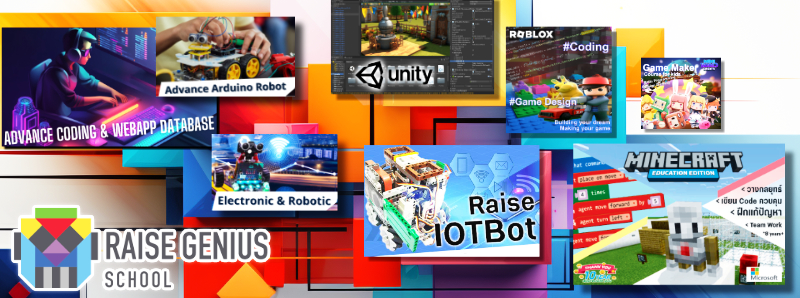
Begin with blocks: a familiar environment such as Minecraft Education can provide simple commands with visible results. Practise sequences, loops and conditions before a more demanding system.
Develop programming confidence: Roblox Game Maker is described from nine with some block-coding background. Creating behaviour and debugging a game can extend an existing foundation.
Connect code with a practical device when ready: the source describes IoT and automation projects that use sensor input and controlled actions, with later introductory AI ideas. Not every sensor rule or conditional command is machine learning.
The school’s published IOTBot & AI example
The article gives ages nine to fourteen and some previous programming experience for its cited IOTBot & AI course. It describes small groups, LEGO Technic-based practical work and block programming.
The source mentions three experienced FIBO-background robotics teachers and an original THB 9,900 course figure, with promotions to confirm. These are published examples rather than independently checked current staffing, equipment or fees.
An intended automation task might use a sensor to trigger a response. Ask the teacher which parts involve ordinary control logic and which introduce an AI concept, and what the child should be able to explain.
Younger learners can build foundations
The body describes Minecraft Education from six, while its closing pathway gives eight to nine as an illustrative starting stage. These are examples of different readiness points, not a new fixed minimum for every class.
The original mentions weekend live communication through Discord. Confirm an age-appropriate arrangement that follows the platform’s rules; a young course entry age is not permission to create an underage account.
Encourage the child to investigate a failed command and try a change without treating the first mistake as failure of the learner. Ask whether they can explain a condition, a repeated action and a simple bug.
For younger learners, AI learning starts with a concrete task they can explain. Ask what information the program receives, which instruction it follows and how the child knows the result is correct. These questions connect the source’s coding foundations with later project work.
What to ask before choosing the next class
Show the team the learner’s actual previous work, not just the title of a completed course. Ask about required coding knowledge, the physical kit, supported software, group size and current learning outcomes.
The source’s broad references to school AI uptake and NECTEC are context from its publication, not new statistics or a claim that one course guarantees advanced AI ability.
Choose a manageable project that the learner wants to understand. A step-by-step foundation can remain worthwhile even when classmates follow a different pace.
Discuss AI learning as a progression rather than a single software skill. Ask the teacher which coding and project skills the child will practise first, what evidence of understanding will be shared, and which experience is needed before a more advanced activity.
Original photographs and artwork
These images are retained from the original page as examples of published learning activities and programme information. Some contain Thai text or historical dates. They do not guarantee the same result for a new learner. Confirm current programmes with the team.
View original images

Frequently asked questions
Can a child begin AI learning with advanced theory?
The article favours programming foundations first. The appropriate activity depends on experience; advanced theory is not required for a beginner’s first lesson.
What experience is listed for IOTBot & AI?
This source describes some prior coding for ages nine to fourteen. Confirm the exact current prerequisites rather than apply another article’s age example.
Is using a chatbot the same as AI learning?
Using a tool and explaining a system are different learning tasks. The source emphasises coding, debugging and practical understanding before more demanding projects.
Contact and related pages
Tell the team about the learner or organisation, relevant experience and the intended learning purpose. Confirm the current programme, equipment, availability, schedule and fees before booking.
Contact Raise Genius School service overview
- Benefits of Robotics Learning for Children
- Minecraft Education: First Coding Steps for Primary Learners
- When to Start a Robotics and AI Portfolio
- Equipment, Curriculum and Training for a School Robotics Club
- Starting an AI or IoT Project for a Portfolio
- Choosing a Coding Course for Children: A Family Guide
- A Guide to School Robotics and STEM Camps
- Roblox Game Making or Minecraft Education: Where to Begin?
- Robotics Engineering Careers and a Changing AI Workplace
Course-selection guide · Robotics portfolio projects · Competition preparation · Team advice and coaching · Course guide · General FAQ
Related services: School robotics camps · STEM activity stations
Related learning: Raise Maker Arduino · micro:bit robotics · IOTBot & AI · Portfolio preparation · Camp proposal · Accompanying teachers
Related reference: IPST STEM resources (Thai)