
Creative Robot Projects: Seven Student Ideas
RAISE GENIUS · PARENTS & SCHOOLS
Creative Robot Projects: Seven Student Ideas
Creative robot projects in this archive show learners adapting structures, materials and movement to an idea. They are classroom models, not equipment certified for real-world use.
Contact the teamOn this page
Creative robot projects inspired by healthcare
The first project is a three-arm model made by Gewvil and Phum. The source reports three controller units, eight motors and around fifteen hours of work, with a teddy bear acting as the patient. It associates the project with an Innovation Award in an FLL 2014 event. Those are the original archive’s details, not a new independent award verification.
Another project by Ho-i resembles a hospital wheelchair or patient trolley. The article describes repeated changes to improve the appearance. Both examples borrow an idea from healthcare, but neither model is a medical device, a treatment tool or equipment intended to carry a person.
Characters, materials and a moving attraction
Ho-i’s Spinosaurus-inspired robot uses reused material to form a distinctive fin where the standard pieces did not create the desired shape. Focus’s monster model uses decoration and part choices to give the construction its character. These examples highlight decisions about appearance as well as movement.
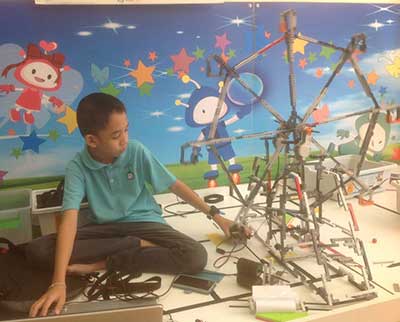
Pee’s moving amusement-ride model starts when its banknote-triggered mechanism is activated. The source describes more than ten hours of building and revision before it was displayed at a Songkran event. This is a model interaction, not instructions for a payment system or a passenger-carrying ride.
Creative robot projects with lifting and balance
A model rocket-launch platform uses a scissor-style lifting mechanism. The original notes that the model rocket was heavy enough to need some hand support. That limitation is part of the story: it is a moving display, not a functioning rocket or launch system.
The seventh example is Phum’s rotating support for a toy gun model, described as a balance and structural-support challenge. The archive reports about three hours of work. This page records that the model existed without explaining weapon construction, firing mechanisms or how to improve a weapon’s performance.
What the seven examples have in common
The author celebrates learners turning an idea into a construction and making changes until the result is more convincing. Some decisions involve mechanisms; others involve appearance, reused material or interaction. Naming the change and its purpose helps make the learning visible.
The stories are individual examples, not evidence that every student will win a competition or reproduce the same result in the same number of hours. Confirm current classes separately. Original photographs and video links remain as the published archive, and some artwork may retain Thai wording.
Original photographs and artwork
These images are retained from the original page as examples of published learning activities and programme information. Some contain Thai text or historical dates. They do not guarantee the same result for a new learner. Confirm current programmes with the team.
View original images


Original video archive
Choose a link to open the original video on YouTube. No external player, automatic playback or YouTube thumbnail is loaded here. The clips are retained from the published archive; their language, availability and content belong to the original upload.
Frequently asked questions
Are the healthcare models usable medical equipment?
No. They are classroom projects and must not be used for treatment or to carry a person.
Does the rocket platform launch a real rocket?
No. The source describes a model display with a lifting mechanism.
Are the reported times standard lesson requirements?
No. They describe individual projects in the archive.
Does this page verify the historical award independently?
No. It accurately attributes the award statement to the original school article.
Contact and related pages
Tell the team about the learner or organisation, relevant experience and the intended learning purpose. Confirm the current programme, equipment, availability, schedule and fees before booking.
Contact Raise Genius School service overview
- Offline Translator: The ili Device in the Archive
- Waterwheels and Steam Engines: How Power Changed Work
- Cleaner Energy: Sunlight, Wind and Water
- 2017 Study Advice: AI, Energy and Biosciences
- Vehicle Power: Electric, Hydrogen and Compressed-Air Ideas
- Steam Power: An Invention that Changed Machines
- Everyday Robots: Household Ideas from the Archive
- Future Robots: Four Examples from a 2016 Story
- Robot Construction: Ready-Made Toys and LEGO Kits
Course-selection guide · Robotics portfolio projects · Competition preparation · Team advice and coaching · Course guide · General FAQ
Related services: School robotics camps · STEM activity stations
Related learning: Raise Maker Arduino · micro:bit robotics · IOTBot & AI · Portfolio preparation · Camp proposal · Accompanying teachers
Related reference: School services


