
Building, Testing, Troubleshooting and Explaining
RAISE GENIUS · PARENTS & SCHOOLS
Building, Testing, Troubleshooting and Explaining
Attention during construction play is described through classroom observations in this archive. The examples are learning situations, not an ADHD diagnosis or treatment.
Contact the teamOn this page
Attention during construction play without a label
The source opens with concerns about children who are active, distracted or absorbed by games. Those observations alone cannot establish ADHD, and city life, hurried routines or a screen should not be presented here as a proven diagnosis or cause.
Cooking, drawing, craft and robot construction are suggested as possible activities. Choose a manageable task the learner is willing to try. A lasting difficulty across daily situations deserves an appropriate professional discussion rather than a promise that a toy will resolve it.
First, building a visible structure
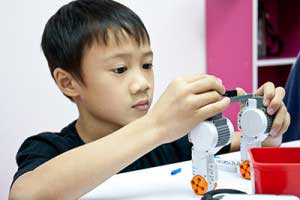
The author describes a learner deciding where a beam could connect two motors. A lesson was described as two hours, with a personally chosen project sometimes holding the learner’s interest.
That is an account of particular classes, not a requirement to sit still for two uninterrupted hours. Instructions, breaks, movement and assistance should be adapted to the person and task.
Second, observe a test; third, investigate a problem
After building, the learner can watch whether the robot runs, turns or follows its programme, while keeping it away from an edge or a falling hazard.
When something does not work, the source describes turning the model, viewing another side, checking steps and asking a teacher. This creates a reason to observe and make a considered change. Using more senses simultaneously is not a universal rule that guarantees concentration.
Fourth, explain the project
The learner may describe an idea, a difficulty, the structure and the project’s name while demonstrating. Offer a comfortable way to share and allow a demonstration to be paused when speaking and operating at once is difficult.
The original claims a certain improvement in concentration. This English edition presents attention during construction play as an opportunity to practise particular tasks, not proof of a clinical outcome. Historical school contact and UTO/UBI references are not a newly verified programme endorsement.
Original photographs and artwork
These images are retained from the original page as examples of published learning activities and programme information. Some contain Thai text or historical dates. They do not guarantee the same result for a new learner. Confirm current programmes with the team.
View original images


Frequently asked questions
Can this page diagnose ADHD?
No. Diagnosis involves a qualified assessment and information beyond one activity.
Must a learner sit still for two hours?
No. Adapt the task, support, movement and breaks.
Does building a robot guarantee improved concentration?
No. The article describes opportunities and observations rather than a measured treatment result.
Contact and related pages
Tell the team about the learner or organisation, relevant experience and the intended learning purpose. Confirm the current programme, equipment, availability, schedule and fees before booking.
Contact Raise Genius School service overview
- Teacher Bung’s Memories and Ideas for a School Break
- Robotics, Cooking, Sport, Numbers, Languages and Clay
- An Archive Comparison with Weekend Learning
- Talking about Children’s Projects with Care
- Construction, Textures, Balance and Whole-Body Activity
- Keeping Space for Conversation, Movement and Making
- Making “A Little Longer” Clear and Manageable
- Build a Set, Make a New Model and Tell a Story
- A Moral Dilemma as a Conversation, Not a Test
Course-selection guide · Robotics portfolio projects · Competition preparation · Team advice and coaching · Course guide · General FAQ
Related services: School robotics camps · STEM activity stations
Related learning: Raise Maker Arduino · micro:bit robotics · IOTBot & AI · Portfolio preparation · Camp proposal · Accompanying teachers
Related reference: NAEYC: developmentally appropriate practice · CDC: diagnosing ADHD


