
Materials, Propulsion, Navigation and a Historical Correction
RAISE GENIUS · PARENTS & SCHOOLS
Materials, Propulsion, Navigation and a Historical Correction
Exploring boat design history takes the archive from a film-inspired question to changing hulls and propulsion. The story needs care with historical dates and claims.
Contact the teamOn this page
Exploring boat design history from an interest in Dunkirk
The source begins with the film Dunkirk and Charles Lightoller, who survived Titanic and later took part in the Dunkirk evacuation aboard Sundowner. It uses his interest in boats as a starting point.
The archive also gives a compressed account of his naval career, including a submarine-command claim. That detailed biography is not independently established here and should not be repeated as verified fact from this page.
Early vessels and Egyptian examples
The article describes early small craft and later Egyptian reed boats and larger vessels. These are different construction traditions; a surviving object is not necessarily the first boat ever invented.
The Great Pyramid boat should not be confused with a reed craft. The Grand Egyptian Museum describes Khufu’s boat as wooden, including cedar, at approximately forty-two metres. The source’s different size and compressed chronology should not be treated as an exact archaeological account.
Oars, sails and the purpose of a hull
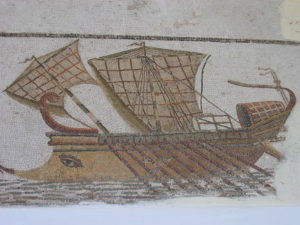
The source mentions galleys and triremes using oars and sails, then discusses stronger ocean-going hulls, deeper keels and navigation during later voyages. Ancient Mediterranean vessel types did not all begin in the one year given by the archive.
Nor is boat development a single straight transfer from Egypt to Rome and then the rest of the world. Different communities developed vessels suited to local materials, waters and purposes. A model can help discuss stability, movement and carrying a load without pretending to reproduce that whole history.
The first circumnavigation was completed by a crew
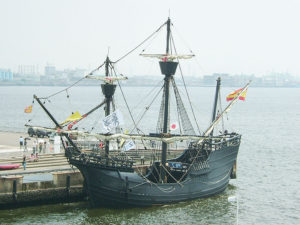
The archive names Ferdinand Magellan as the first person to travel around the world. More accurately, his expedition began in 1519, and the surviving Victoria completed the voyage under Juan Sebastián Elcano in 1522 after Magellan’s death.
The ship image labelled Victoria belongs to that part of the article. The Spanish Navy’s historical account provides primary institutional context for the expedition and completion.
Metal ships and powered propulsion
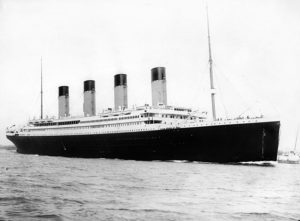
The source moves on to iron and steel hulls, engines, passenger transport and cargo, naming Titanic. Materials and propulsion changed over time; metal construction and an engine are separate design choices rather than one event that instantly replaced all sailing craft.
Exploring boat design history can end with four questions: what carries the load, what provides movement, how is direction controlled and what conditions must the vessel withstand? A classroom model is a learning tool, not a seaworthy craft for people.
Original photographs and artwork
These images are retained from the original page as examples of published learning activities and programme information. Some contain Thai text or historical dates. They do not guarantee the same result for a new learner. Confirm current programmes with the team.
View original images

Frequently asked questions
Was Khufu’s surviving boat a reed boat?
No. The museum describes a wooden vessel including cedar.
Did Magellan personally complete the first circumnavigation?
No. The surviving Victoria returned under Elcano after Magellan’s death.
Is a classroom model suitable for carrying people?
No. It is a way to discuss design, not a certified vessel.
Contact and related pages
Tell the team about the learner or organisation, relevant experience and the intended learning purpose. Confirm the current programme, equipment, availability, schedule and fees before booking.
Contact Raise Genius School service overview
- Curved Motion, Contact Forces and Engineered Restraints
- Positioning, Obstacle Sensing and Service Applications
- Observations, Computer Models and Communicating the Result
- Observation Tools and a Necessary Product Safety Correction
- The Thames Barrier, Boxwall and FloodBreak
- Chemistry, Fingerprint Traces and Reconstructing a Scene
- Infrared, Radio and the Actual Classroom Equipment
- Ideas, Gliders, Control and Building on Earlier Work
- Movement, Mission Tools and the Operating Environment
Course-selection guide · Robotics portfolio projects · Competition preparation · Team advice and coaching · Course guide · General FAQ
Related services: School robotics camps · STEM activity stations
Related learning: Raise Maker Arduino · micro:bit robotics · IOTBot & AI · Portfolio preparation · Camp proposal · Accompanying teachers
Related reference: Grand Egyptian Museum: Khufu’s boats · Spanish Navy: the first circumnavigation
