
Encourage Children to Try, Make and Recognise Progress
RAISE GENIUS · PARENTS & SCHOOLS
Encourage Children to Try, Make and Recognise Progress
Encouraging confidence through activities is the source’s focus. It asks how children can experience doing something for themselves in schoolwork, sport or making a model, while adults recognise the effort involved.
Contact the teamOn this page
Encouraging confidence through activities and experience
The article uses Erik H. Erikson’s industry versus inferiority framework to discuss competence during the school years. It refers to ages five to twelve, and elsewhere six to twelve, while describing the growing importance of teachers and peers.
Those ranges explain the archive’s theoretical context; they are not a diagnosis or a deadline. Confidence can change through later experiences too, and one unsuccessful task does not determine a child’s personality or future.
Choose a manageable task and recognise what happened
The source connects confidence with opportunities to attempt a task and recognise that something was achieved through the child’s own work. Its examples include homework, sport and creating a model or other object.
A task can be adjusted so it offers a real challenge with suitable help. The adult can ask how the learner approached it, what changed during an attempt and which part the learner completed independently.
An attempt that does not work can still provide something to discuss. Avoid equating a model’s success with the child’s worth or promising that every activity must end in immediate success. The aim is to support continued participation.
Construction offers different levels of challenge
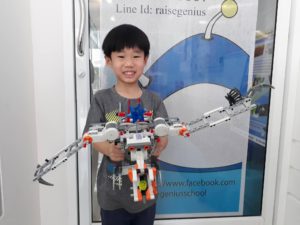
The archive presents LEGO as a material that can be used for a simple structure or a more complex design. A learner can return to familiar pieces with a different idea as interests and experience develop.
Raise Genius describes robotics classes as a place to make and test models with teacher guidance. This is an account of the intended activity, not evidence that one brand or course treats low confidence or guarantees a lasting personality change.
The source used confidence as an accessible description of the competence discussed in Erikson’s framework, rather than a literal translation of industry. Contact the team to discuss a suitable activity, current class support and whether any trial offer is available.
Original photographs and artwork
These images are retained from the original page as examples of published learning activities and programme information. Some contain Thai text or historical dates. They do not guarantee the same result for a new learner. Confirm current programmes with the team.
View original images

Frequently asked questions
Are ages five to twelve a deadline for confidence?
No. They are broad ranges used in the archive’s discussion of Erikson, not a fixed developmental deadline.
Does a failed model mean the activity was harmful?
A model’s result does not determine a child’s worth. Discuss the attempt, adjust the task and provide appropriate help.
Does a robotics class guarantee greater confidence?
No. It can offer opportunities to try and explain a project, without guaranteeing a personality change or treating a wellbeing concern.
Contact and related pages
Tell the team about the learner or organisation, relevant experience and the intended learning purpose. Confirm the current programme, equipment, availability, schedule and fees before booking.
Contact Raise Genius School service overview
- From STEM to STEAM: Connecting Knowledge with New Ideas
- Why Do Some Children Enjoy Learning during the Holidays?
- Choose Toys around Age, Interests and Readiness
- From Concrete Examples to Abstract Thinking
- Learn a Little, Return to It and Make Practice Manageable
- Pretend Play: Build a Story with Flexible Materials
- Help Children Explore Their Interests through Activities
- Find Shared Activities for Siblings of Different Ages
- Practise Analytical Thinking through Questions and Making
Course-selection guide · Robotics portfolio projects · Competition preparation · Team advice and coaching · Course guide · General FAQ
Related services: School robotics camps · STEM activity stations
Related learning: Raise Maker Arduino · micro:bit robotics · IOTBot & AI · Portfolio preparation · Camp proposal · Accompanying teachers
Related reference: NAEYC: development and learning principles
