
Guidance, Support, Power and Different Transport Concepts
RAISE GENIUS · PARENTS & SCHOOLS
Guidance, Support, Power and Different Transport Concepts
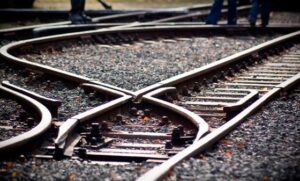
Railway track design ideas begin with why a train follows rails. The archive connects smoother transport routes with later locomotives and newer concepts.
Contact the teamOn this page
Railway track design ideas and a compressed history
The source tells a story of an Egyptian cart route, then mine wagonways in Europe and steam locomotives. Its claim that trains formally began in Germany is too broad to use as a single origin.
Railway history contains different milestones: guided routes, wagonways, steam locomotives and public services. The Science Museum Group’s historical overview identifies Trevithick’s 1804 train-hauling locomotive as one such milestone. The archive’s unnamed ancient inventor is not independently verified here.
A supported route can help move a load
The article’s main design idea is that a suitable guided surface can make transport more manageable than a rough route. Rolling resistance, gradient, wheel and rail condition and the load all matter.
Rails, sleepers and their support form a system rather than a perfectly frictionless path. Traction is still needed for starting and braking, so “less friction” is not a complete account of every railway function.
Power supply is a separate design choice
The source notes that some electric systems use track-associated power supply. Other trains use overhead wires or another arrangement; ordinary running rails are not universally the power source.
Children should never approach real track equipment for an experiment. A low-voltage learning model is a different setting with different hazards and supervision needs.
Maglev and low-pressure concepts are different
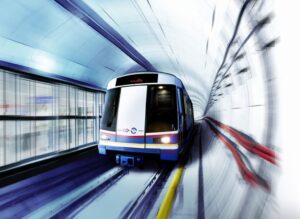
The archive mentions magnetic levitation and a “vacuum track”. Maglev and low-pressure tube proposals are different technologies and should not be presented as one ordinary railway design or an already available service everywhere.
Railway track design ideas can be explored with a safe small model: compare a route, a support or a gentle curve and explain what changed. The article does not confirm current Thai construction schedules or promise a particular model’s performance.
Original photographs and artwork
These images are retained from the original page as examples of published learning activities and programme information. Some contain Thai text or historical dates. They do not guarantee the same result for a new learner. Confirm current programmes with the team.
View original images

Frequently asked questions
Is there one simple origin date for all railways?
No. Distinguish routes, wagonways, locomotives and services.
Do all electric trains get power through the running rails?
No. Power arrangements differ.
Are maglev and low-pressure tube concepts identical?
No. They involve different design principles.
Contact and related pages
Tell the team about the learner or organisation, relevant experience and the intended learning purpose. Confirm the current programme, equipment, availability, schedule and fees before booking.
Contact Raise Genius School service overview
- Instructions, Shared Services and Familiar Devices
- From a Checkout Belt to an Airport Baggage System
- A Wire-Walking Video and the Hardware–Software Relationship
- An Apparent Endless Mechanism Needs an Energy Explanation
- Recognising Containers, Recording a Return and Sorting
- Changing Direction, Sharing a Load and Pulling More Rope
- Search, Training and What Self-Play Does Not Prove
- Hadrian, Wall Construction and the Rest of a Building
- Pretend Roles, Stories, Shared Building and Personal Designs
Course-selection guide · Robotics portfolio projects · Competition preparation · Team advice and coaching · Course guide · General FAQ
Related services: School robotics camps · STEM activity stations
Related learning: Raise Maker Arduino · micro:bit robotics · IOTBot & AI · Portfolio preparation · Camp proposal · Accompanying teachers
Related reference: Science Museum Group: landmarks in railway history
